
Ingredients Categories
Finished Products
Finished Food Categories
- Bakery
- Beverages / Juices
- Cereal and grain products
- Confectionery
- Cooking Fats & Oils
- Dairy
- Egg products
- Fruits & Vegetables
- Infant & Baby food
- Meat, Poultry & Fish
- Nuts & Seeds products
- Other Finished Food Categories
- Pet Food
- Plant-based foods
- Prepared foods
- Sauces & Seasonings
- Sweet & Savoury Spreads
Specialised Finished Products
- Bee products
- Biotic products
- Dietary supplements
- Energy drinks
- Functional beverages
- Functional confectionery
- Functional food
- Functional powders
- Meal replacement products
- Nutricosmetics
- Other Specialised Finished Products
- Pet Dietary Supplements
- Pharma and OTC products
- Protein products
- Sugar replacers / Sweeteners
Health & Wellness Areas
Delivery Formats
Operations & Services
- 3D printing
- Analysis/ Testing
- Auditing & certifications
- Blending & mixing
- Bottling
- Certification
- Clinical trials
- Co-packing
- Coating
- Consulting
- Contract manufacturing
- Drying
- Electrospinning
- Encapsulating
- Enzymatic processing
- Extracting
- Extrusion
- Fat structuring
- Fermentation
- Filling
- Flavour development
- Freeze drying
- Granulating/ grinding/ milling / mixing
- High-pressure processing
- Labelling
- Other Operations & Services
- Packaging
- Packet filling
- Pasturising
- Quality assurance
- Saccharification
- Shear cell processing
- Spray drying
- Sterilisation
- Storage & Logistics
- Tabletting
- Toasting / roasting
- Ultra-high temperature processing
News
Healthy and humane: Noochies launches pet food that is factory farming-free
Niamh Michail, Head of Publishing 15 Sep 2023
US pet food brand Noochies uses nutritional yeast to make its meat-free, healthy dog food and freeze-dried snacks for cats and dogs – a humane pet food range that is free from factory farming meat, it says.
The US company’s portfolio currently includes two dog food products available in plastic pouches – one for breakfast and one for dinner – and two freeze-dried snack products, one for dogs and one for cats. In addition to nutritional yeast, the breakfast dog food is made with oats, sweet potato, and peanut butter while the dinner dog food contains pumpkin seeds, squash, and sprouted grains. All its products are enriched with Bmmune, its patented ingredient blend of fermented proteins and nutritional yeast that has an amino acid profile similar to chicken or lamb and is a complete protein for dogs.

The high-protein, meat-free, freeze-dried dog snacks – launched this month – are a category first in the US, the company claims.
‘Pet food today is over-processed and over-supplemented’
Although animal meat is the traditional diet of cats and dogs, Joshua Errett, founder and interim CEO of Noochies, told Ingredients Network that pet food products today tend to be far from natural. This was his inspiration to develop Noochies.
“Pet food today is over-processed and over-supplemented, to the point where meat doesn't play as large of a role in food as you might think,” he said. “Take for instance the inclusion of synthetically produced taurine in cat food. Taurine is an essential amino acid, meaning cats cannot produce on their own, and is naturally found in animal flesh. So why do we have to add it to almost all meat-based foods?
“And if indispensable nutrients like taurine that are supposed to be in meat instead have to be added, why include meat at all? This is what started me on a path to find more sustainable ingredients than factory farmed meats. I don't yet have a complete protein solution for cats – true carnivores – I am working on it!”
It uses nutritional yeast as the main protein base for its products – but the ingredient is not completely novel in the pet food category.
“[It] appears in probably 99% of commercial pet food already,” Erret said. “It is a natural ingredient that is high in protein, high in fibre, and high in B complex vitamins that boost immunity, energy, nutrient absorption, and all kinds of other benefits. It is certainly comparable to meat in amino acid profile – it actually is a complete protein for dogs, containing all the amino acids a canine needs.”
Noochies also fortifies its products, and its dog food meets US regulatory requirements for complete nutrition for animals. Its snacks, which are intended to be fed to cats and dogs intermittently as a treat, are not nutritionally complete products.
Premium positioning: ‘Price does not win in this market’
The products are undoubtedly premium: one 454 g pouch retails for $27.00 on Noochies’ website while one packet of freeze-dried snacks costs $13.99.
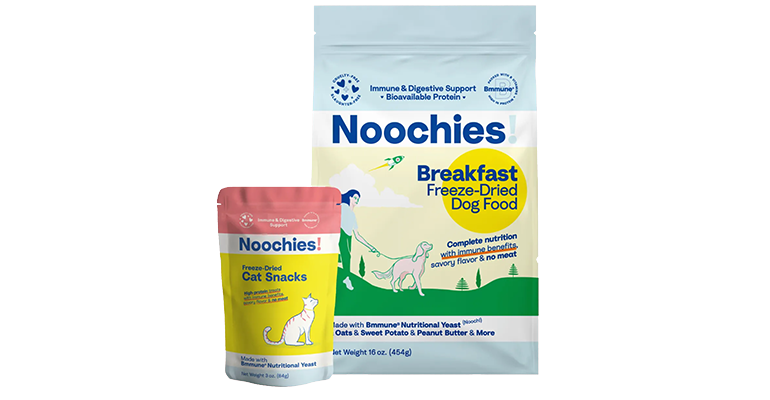 Image credit: Noochies/Joshua Erret
According to Erret, producing cheap pet food does not necessarily make sense strategic business sense in the US – even given the current inflationary climate and global cost-of-living crisis.
“If you look at the pet market, consumers are not buying low priced foods. The opposite is happening. Low-cost brands are not growing, and on a macroeconomic scale, consumers are buying less products for more money. That's because price does not win this market. People want their pets to be healthy and will pay for quality products that provide health benefits.”
The entrepreneur said that Noochies products deliver key health benefits to cats and dogs – notably, for immunity, digestion, and longevity – and this was far more important to the company and consumers than price parity with factory farmed chicken.
Erret described Noochie products as sustainable, humane, and healthy, and said the brand’s target consumers were those looking to feed their animals “harm-free” pet food that was free from factory farmed meat. Younger generations were particularly receptive to these values, he added.
Cell-cultivated pet food could launch in 2024
Erret is also vice president of CULT Food Science, a Canadian company that invests in cellular agriculture startups. Last month (August), CULT announced it had partnered with Singapore-based biotech startup Umami Bioworks to develop a cat food product made using cell-cultivated fish.
The hybrid plant-based/cultivated fish product, called Marina Cat, is also fortified with Bmmune, Noochies' ingredient that it sells to other pet food brands. Commercial production is scheduled to begin later this year with a widespread launch slated for 2024, according to a statement issued by the companies.

Get more of our news on Google
Set Ingredients Network as a 'Preferred Source' to get quicker access to the news you value.
Related news

Do the US dietary guidelines put UPFs under pressure?
10 Sep 2026
Will the US dietary guidelines change the way Americans eat, swapping ultra-processed foods for whole foods? We asked Dr Barry Popkin, renowned nutrition and obesity researcher.
Read more
Food fraud costs UK economy £2bn each year
9 Sep 2026
Food fraud is costing the UK economy up to £2 billion (€2.3 billion) every year although the food sector is more “resilient” than others, according to a recent study.
Read more
Kellogg accelerates work to remove artificial colours from all US cereals
3 Sep 2026
WK Kellogg has announced an accelerated timeline to eliminate all artificial colours and the chemical preservative, BHT, across its full US portfolio of cereals and cereal packaging.
Read more
Skimpflation: An ‘unfair’ and risky approach to keeping prices low
2 Sep 2026
Consumers see skimpflation – reducing the quality of ingredients due to rising costs – as more unfair than shrinkflation, making it a risky strategy according to recent research.
Read more
‘Urgent gaps’ in achieving 2030 food system goals
27 Aug 2026
Global food systems are failing to meet 2030 targets across indicators including health, environment, and resilience, according to a report co-authored by the Food and Agriculture Organisation (FAO).
Read more
Seven-Eleven uses microbial testing tech to extend katsudon shelf life
26 Aug 2026
Japanese retail company Seven-Eleven has improved its factory’s microbial environment to keep comfort-food staple, katsudon, fresher for longer.
Read more
Chimac’s fusion sauces bring Korean flavours to Europe
25 Aug 2026
Irish sauce brand Chimac is tapping into Korea’s culinary traditions, bringing its flavours and products to European consumers who want a taste of K-food.
Read more
Global demand for instant noodles continues to rise
24 Aug 2026
Global demand for instant noodles reached 124.21 billion servings last year, representing a 0.7% year-on-year increase – or 900 million extra servings.
Read more
China beverages: Is herbal innovation the future?
20 Aug 2026
Herbal and botanical innovation in China's drinks market continues to grow, with ingredients like astragalus root, ginger, and ginseng in the spotlight – and focus shifting far beyond refreshment.
Read more
Popular barbecue staples experience sharp price increases
19 Aug 2026
The typical cost of US shoppers’ barbecue baskets has risen by 12% over the past year – the fastest annual rise in a decade, figures from The Economist show.
Read more