
Ingredients Categories
Finished Products
Finished Food Categories
- Bakery
- Beverages / Juices
- Cereal and grain products
- Confectionery
- Cooking Fats & Oils
- Dairy
- Egg products
- Fruits & Vegetables
- Infant & Baby food
- Meat, Poultry & Fish
- Nuts & Seeds products
- Other Finished Food Categories
- Pet Food
- Plant-based foods
- Prepared foods
- Sauces & Seasonings
- Sweet & Savoury Spreads
Specialised Finished Products
- Bee products
- Biotic products
- Dietary supplements
- Energy drinks
- Functional beverages
- Functional confectionery
- Functional food
- Functional powders
- Meal replacement products
- Nutricosmetics
- Other Specialised Finished Products
- Pet Dietary Supplements
- Pharma and OTC products
- Protein products
- Sugar replacers / Sweeteners
Health & Wellness Areas
Delivery Formats
Operations & Services
- 3D printing
- Analysis/ Testing
- Auditing & certifications
- Blending & mixing
- Bottling
- Certification
- Clinical trials
- Co-packing
- Coating
- Consulting
- Contract manufacturing
- Drying
- Electrospinning
- Encapsulating
- Enzymatic processing
- Extracting
- Extrusion
- Fat structuring
- Fermentation
- Filling
- Flavour development
- Freeze drying
- Granulating/ grinding/ milling / mixing
- High-pressure processing
- Labelling
- Other Operations & Services
- Packaging
- Packet filling
- Pasturising
- Quality assurance
- Saccharification
- Shear cell processing
- Spray drying
- Sterilisation
- Storage & Logistics
- Tabletting
- Toasting / roasting
- Ultra-high temperature processing
News
Low-calorie nutrient-rich milk launched to battle dairy alternatives
Simon Pitman, Freelance Journalist 7 Apr 2025Plant-based milk has carved out a growing slice of the milk market in recent years, but now Dairy Farmers of America is pitching its Milk50 by DairyPure to claw back more of the market share.
Dairy alternatives, particularly plant-based offerings such as almond and oat milk, have been marketed on the strength of improved nutritional and calorie profiles when compared to both whole and reduced-fat dairy milk products.
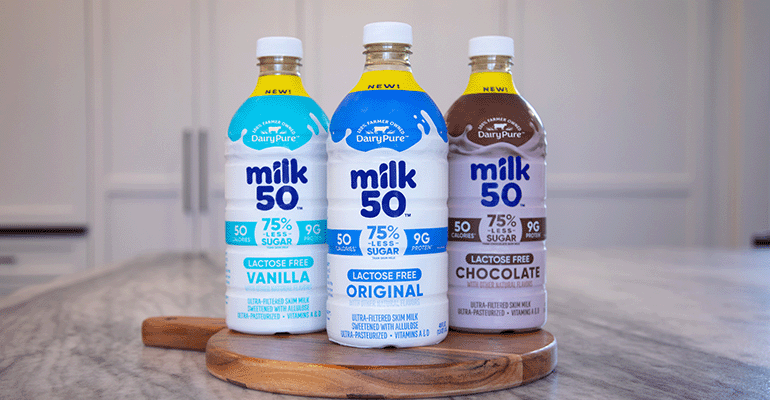
Milk50 is a range of flavoured milks positioned with an enhanced nutritional profile that combines just 50 calories and nine grams of protein per serving, alongside a lactose-free formulation. It is available in original, chocolate, and vanilla flavours, and contains 75% less sugar compared to fat-free skimmed milk.
In the US, dairy milk continues to dominate the dairy and alt-dairy market, but plant-based milks have been gradually eating into market share.
According to Markets & Markets, dairy milk still holds the majority of the US market share at 84%, but this is down from 88% in 2018. Its figures show that plant-based milk now accounts for 16% of the total milk market, up from 12% in 2018.
A milk formulated to outdo dairy and non-dairy offerings
Rachel Kyllo, chief marketing officer of dairy brands at Dairy Farmers of America, believes its latest milk offering will not only provide a competitive edge against the long-term trend for plant-based milk but will also provide more choice in the low-fat dairy milk category.
“Milk50 is designed for people who are looking for ways to cut down on calories and reduce sugar,” said Kyllo. “These calorie-conscious consumers may have turned to plant-based beverages because these drinks are typically lower in calories and sugar compared to milk, yet many of these consumers have been disappointed by the taste and nutrition of these alternatives.”
Kyllo went on to point out that while Milk50 is low in calories, it also has significantly higher protein levels than most plant-based milks and lower sugar levels, which may appeal to individuals wanting to reduce their calorie intake, as well as diabetics.
Advanced filtration removes 75% of sugars
“Compared to 2% reduced fat milk, Milk50 is fat free and is lower in calories (50 vs. 120), while maintaining protein and other key nutrients. An advanced ultra-filtration process removes 75% of the sugar found in fat-free skim milk, so Milk50 contains only 2-3 grams of sugar (depending on the flavour), compared to 12 grams of sugar in regular 2% milk,” Kyllo explained.
A 2023 McKinsey report found that 65% of US households purchased both dairy and non-dairy milk, indicating a growing trend for both categories. Yet, 40% of consumers purchasing plant-based milk expressed dissatisfaction with the taste and nutritional profile of non-dairy options, creating an opportunity for innovative dairy products like Milk50.
Development behind Milk50 emphasised full flavour
Kyllo also pointed to the fact that this shift in consumer preferences has led to increased demand for products that are both nutrient rich and low in sugar without compromising on taste.
This is why the development team behind the new beverage range placed a significant emphasis on its taste and mouthfeel.
“Milk50 removes 75% of the sugar naturally found in milk through an ultra-filtration process while preserving protein and key nutrients. To maintain a slightly sweet, balanced flavour, a small amount of allulose, along with stevia leaf, was chosen as the sweeteners for the original and vanilla flavours,” Kyllo said.
The company said that allulose was chosen because it is a low-calorie sweetener with the taste and texture of sugar but with around 10% of the calories. It also pointed to research showing that allulose does not raise blood sugar levels, making it suitable for consumers looking to lower their sugar intake while not compromising on flavour.
Additionally, Kyllo said Milk50 is well suited to individuals looking to maintain muscle tone and satiety after taking GLP-1 medications, diabetics, as well as consumers looking for full-flavour, lactose-free options.

Get more of our news on Google
Set Ingredients Network as a 'Preferred Source' to get quicker access to the news you value.
Related news

Do the US dietary guidelines put UPFs under pressure?
10 Sep 2026
Will the US dietary guidelines change the way Americans eat, swapping ultra-processed foods for whole foods? We asked Dr Barry Popkin, renowned nutrition and obesity researcher.
Read more
Food fraud costs UK economy £2bn each year
9 Sep 2026
Food fraud is costing the UK economy up to £2 billion (€2.3 billion) every year although the food sector is more “resilient” than others, according to a recent study.
Read more
Skimpflation: An ‘unfair’ and risky approach to keeping prices low
2 Sep 2026
Consumers see skimpflation – reducing the quality of ingredients due to rising costs – as more unfair than shrinkflation, making it a risky strategy according to recent research.
Read more
NielsenIQ’s EU barometer shows Britain leading in grocery inflation
31 Aug 2026
Britain was the only country to record grocery inflation above 2%, according to NielsenIQ data that compared Europe’s five biggest grocery markets from February to May 2026.
Read more
‘Urgent gaps’ in achieving 2030 food system goals
27 Aug 2026
Global food systems are failing to meet 2030 targets across indicators including health, environment, and resilience, according to a report co-authored by the Food and Agriculture Organisation (FAO).
Read more
China beverages: Is herbal innovation the future?
20 Aug 2026
Herbal and botanical innovation in China's drinks market continues to grow, with ingredients like astragalus root, ginger, and ginseng in the spotlight – and focus shifting far beyond refreshment.
Read more
Popular barbecue staples experience sharp price increases
19 Aug 2026
The typical cost of US shoppers’ barbecue baskets has risen by 12% over the past year – the fastest annual rise in a decade, figures from The Economist show.
Read more
Beyond 'nice to have': A spotlight on US functional beverages
12 Aug 2026
Functional beverage interest in the US is gaining important ground as consumers now expect function rather than see it as "nice to have", and there are clear market gaps for growth, according to Spate.
Read more
Manam Chocolate aims to bring premium Indian cacao to 'the world stage'
11 Aug 2026
Craft chocolate brand Manam Chocolate is investing in local expansion and supply chain innovation throughout India as it works to build out the premium reputation of its locally produced cacao products.
Read more
Digital twin technology gains ground in food manufacturing
6 Aug 2026
Food and beverage companies are increasingly turning to digital twins to optimise and automate manufacturing processes, but opportunities stretch far beyond this, say experts.
Read more