
Ingredients Categories
Finished Products
Finished Food Categories
- Bakery
- Beverages / Juices
- Cereal and grain products
- Confectionery
- Cooking Fats & Oils
- Dairy
- Egg products
- Fruits & Vegetables
- Infant & Baby food
- Meat, Poultry & Fish
- Nuts & Seeds products
- Other Finished Food Categories
- Pet Food
- Plant-based foods
- Prepared foods
- Sauces & Seasonings
- Sweet & Savoury Spreads
Specialised Finished Products
- Bee products
- Biotic products
- Dietary supplements
- Energy drinks
- Functional beverages
- Functional confectionery
- Functional food
- Functional powders
- Meal replacement products
- Nutricosmetics
- Other Specialised Finished Products
- Pet Dietary Supplements
- Pharma and OTC products
- Protein products
- Sugar replacers / Sweeteners
Health & Wellness Areas
Delivery Formats
Operations & Services
- 3D printing
- Analysis/ Testing
- Auditing & certifications
- Blending & mixing
- Bottling
- Certification
- Clinical trials
- Co-packing
- Coating
- Consulting
- Contract manufacturing
- Drying
- Electrospinning
- Encapsulating
- Enzymatic processing
- Extracting
- Extrusion
- Fat structuring
- Fermentation
- Filling
- Flavour development
- Freeze drying
- Granulating/ grinding/ milling / mixing
- High-pressure processing
- Labelling
- Other Operations & Services
- Packaging
- Packet filling
- Pasturising
- Quality assurance
- Saccharification
- Shear cell processing
- Spray drying
- Sterilisation
- Storage & Logistics
- Tabletting
- Toasting / roasting
- Ultra-high temperature processing
News
‘Not for EU’ label signals confusion and extra costs
Natasha Mentink, Freelance Journalist 6 Feb 2024With affordability, variety, and choice paramount in today’s uncertain landscape, concerns exist around the UK’s “Not for EU” label.
The “Not for EU” label was agreed with the European Commission and announced as part of the Windsor Framework. Under the Framework’s Northern Ireland Retail Movement Scheme, businesses will be able to move pre-packaged retail goods and certain loose products, including fruit and vegetables, through the “Green Lane”.

The labelling allows goods moving from Great Britain to Northern Ireland to benefit from reduced documentary requirements and fewer checks on arrival in Northern Ireland.
“The Food and Drink Federation and our members are very concerned about the UK Government’s planned introduction of ‘Not for EU’ labelling across the UK,” Balwinder Dhoot, director of sustainability and growth at the Food and Drink Federation (FDF), a British industry body, told Ingredients Network.
The implementation of the ‘Not for EU’ label
Spotted in supermarkets in Northern Ireland as early as August 2023, the “Not for EU” label must be included on consumer packaging for goods deemed highest risk, such as meat and dairy.
For lower-risk items, the label can be applied to the box used to transport the goods. Certain manufacturers, particularly those travelling along a Great Britain to Northern Ireland supply chain-only route, have also voluntarily chosen to adopt the labels for sale in Great Britain.
The label’s introduction will be phased over three periods: October 2023, October 2024, and July 2025. As of October 2023, goods moving into Northern Ireland under the Northern Ireland Retail Movement Scheme must meet the labelling requirements.
Supermarkets in Northern Ireland have been provided with posters to explain the meaning of the label, which may tell customers that the item has been moved from Great Britain to Northern Ireland as part of an internal market scheme, not for sale or consumption in an EU member state.
“This unnecessary policy will add extra costs to food and drink manufacturers during what remains a difficult time for our businesses and will create a new barrier to trading with our largest export markets in Europe,” Dhoot said.
‘Not for EU’ label: A purposeless policy?
“Not for EU” labelling has two core aspects. Introduced in October 2023, the first is the limited and focused labelling of goods that move from Great Britain to Northern Ireland via the “Green Lane”. The second is the planned and more disruptive government plan, the FDF reported, to bring in “Not for EU” labelling on all qualifying products sold in Great Britain, regardless of whether they will be sold in Northern Ireland and including all imported products sold in Great Britain.
In a Northern Ireland context, the label is required to unlock facilitations agreed with the European Commission, without which it may become prohibitive to serve the Northern Ireland marketplace or potentially push up prices.
In relation to Great Britain, there is no benefit and a lack of awareness of what the label means, the FDF said, leading to some of the press stories that have emerged recently.
“We urge the UK Government to work with our industry to find a solution that will avoid costly and unnecessary harm to our businesses and shoppers,” Dhoot said.
Making the label mandatory
From October 2024, the UK government will make the “Not for EU” labelling mandatory across Great Britain. With industry opinion indicating this is a unilateral move that has nothing to do with the negotiated agreement with the European Commission, fears that it is an unnecessary and restrictive policy swirl.
A consultation on this issue is expected in the coming weeks. The consultation comes amid serious concerns about the label’s impact on exports, particularly as dual production runs are needed for UK and EU lines. The export landscape – particularly the Republic of Ireland, reduced investment, and effects to prices and consumer choice – are among these worrying issues.
The government has maintained that this measure is necessary to ensure continued supply in Northern Ireland. The FDF has, however, seen no decline in product availability since the framework was introduced, with manufacturers using the full range of options to supply the Northern Ireland market, including the “Green Lane” with “Not for EU” labels, the “Red Lane”, and via the Republic of Ireland.
In Northern Ireland, manufacturers and retailers must apply the label to ensure products and brands benefit from reduced certification and checks. Manufacturers, therefore, can apply the label or comply with the standard requirements to serve the EU market when supplying Northern Ireland.
 © iStock/gpointstudio
Higher-risk goods that require veterinary-signed certificates, such as Export Health Certificates, are more likely to use the label and “Green Lane” solution, the FDF said. Lower-risk goods that do not have high levels of documentary and physical checks will tend to refrain from using the scheme and serve Northern Ireland via the “Red Lane”.
The concern is that current proposals to make labelling mandatory in Great Britain will significantly impact those not supplying Northern Ireland and overseas suppliers to the UK, who would also need to apply the label, among other considerations.
Helping manufacturers and consumers prepare
Allowing enough time to adapt is essential for the industry to implement on-pack labelling changes, and it is a key recommendation for countries and manufacturers bringing in new labels.
The goods that require on-pack labelling to move from Great Britain to Northern Ireland are tied to EU regulations. The FDF added that the UK government needs to work more collaboratively with the European Commission to issue clear guidance on the products that need the label in different phases to avoid gold-plating the requirements of the Windsor Framework.
Amid reported consumer confusion and disgust over the “Not for EU” label, attention has turned to whether the UK can alleviate such backlash. If education on the label’s meaning is only available in a Northern Ireland context via initiatives such as posters in supermarkets, Great Britain needs to adopt more awareness of the label and its meaning.
More transparent communication on the label’s origin, reaffirming that it has nothing to do with food or production standards, would also help to alleviate confusion.
“Our top priority is to continue to supply shoppers across the UK with the widest variety of affordable food and drink,” said Dhoot.

Get more of our news on Google
Set Ingredients Network as a 'Preferred Source' to get quicker access to the news you value.
Related news

M&S launches own-brand pet food range
11 Sep 2026
UK retailer Marks & Spencer has launched its own-brand pet food line Paws & Pals – a well-timed and strategic move that will appeal to loyal shoppers, says a marketing expert.
Read more
Do the US dietary guidelines put UPFs under pressure?
10 Sep 2026
Will the US dietary guidelines change the way Americans eat, swapping ultra-processed foods for whole foods? We asked Dr Barry Popkin, renowned nutrition and obesity researcher.
Read more
Food fraud costs UK economy £2bn each year
9 Sep 2026
Food fraud is costing the UK economy up to £2 billion (€2.3 billion) every year although the food sector is more “resilient” than others, according to a recent study.
Read more
Kellogg accelerates work to remove artificial colours from all US cereals
3 Sep 2026
WK Kellogg has announced an accelerated timeline to eliminate all artificial colours and the chemical preservative, BHT, across its full US portfolio of cereals and cereal packaging.
Read more
‘Urgent gaps’ in achieving 2030 food system goals
27 Aug 2026
Global food systems are failing to meet 2030 targets across indicators including health, environment, and resilience, according to a report co-authored by the Food and Agriculture Organisation (FAO).
Read more
Chimac’s fusion sauces bring Korean flavours to Europe
25 Aug 2026
Irish sauce brand Chimac is tapping into Korea’s culinary traditions, bringing its flavours and products to European consumers who want a taste of K-food.
Read more
Savoury protein snacks shake up the on-the-go market
10 Aug 2026
Sweet flavours have dominated the high-protein snack category but savoury snacks, such as cheese bars and meat sticks, can appeal to health-conscious consumers.
Read more
Nestlé invests in regeneratively farmed wheat for KitKat
5 Aug 2026
Nestlé will pay a premium for Wildfarmed’s regeneratively farmed wheat but the CPG remains reticent to promote the move on packs of its KitKat bars.
Read more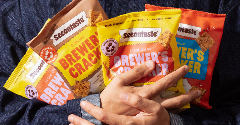
How Secon Taste is putting upcycled snacks on shelves
4 Aug 2026
Hungarian zero-waste startup Secon Taste is turning surplus food into upcycled snacks such as fibre-packed granola, instant porridge, and a circular coffee-tasting box.
Read more
Codex sets global thresholds for ‘may contain’ labels
3 Aug 2026
Codex Alimentarius has adopted its first global guidance on when to use “may contain” allergen warnings, setting thresholds intended to stop the label being used as blanket legal cover.
Read more