
Ingredients Categories
Finished Products
Finished Food Categories
- Bakery
- Beverages / Juices
- Cereal and grain products
- Confectionery
- Cooking Fats & Oils
- Dairy
- Egg products
- Fruits & Vegetables
- Infant & Baby food
- Meat, Poultry & Fish
- Nuts & Seeds products
- Other Finished Food Categories
- Pet Food
- Plant-based foods
- Prepared foods
- Sauces & Seasonings
- Sweet & Savoury Spreads
Specialised Finished Products
- Bee products
- Biotic products
- Dietary supplements
- Energy drinks
- Functional beverages
- Functional confectionery
- Functional food
- Functional powders
- Meal replacement products
- Nutricosmetics
- Other Specialised Finished Products
- Pet Dietary Supplements
- Pharma and OTC products
- Protein products
- Sugar replacers / Sweeteners
Health & Wellness Areas
Delivery Formats
Operations & Services
- 3D printing
- Analysis/ Testing
- Auditing & certifications
- Blending & mixing
- Bottling
- Certification
- Clinical trials
- Co-packing
- Coating
- Consulting
- Contract manufacturing
- Drying
- Electrospinning
- Encapsulating
- Enzymatic processing
- Extracting
- Extrusion
- Fat structuring
- Fermentation
- Filling
- Flavour development
- Freeze drying
- Granulating/ grinding/ milling / mixing
- High-pressure processing
- Labelling
- Other Operations & Services
- Packaging
- Packet filling
- Pasturising
- Quality assurance
- Saccharification
- Shear cell processing
- Spray drying
- Sterilisation
- Storage & Logistics
- Tabletting
- Toasting / roasting
- Ultra-high temperature processing
News
Punishment Juice: M&S criticised over ‘irresponsible’ marketing
Tessa Wiles, Content Editor - Food 24 Jul 2025Marks & Spencer has attracted criticism for its marketing of a vegetable and spirulina cold-pressed drink as Punishment Juice, with commentators labelling it “irresponsible” and “harmful”.
Registered nutritionist Sophie Gastman described the product on LinkedIn as “essentially commodified guilt” and asked: “Why are we so committed to reinforcing the idea that vegetables are gross?”
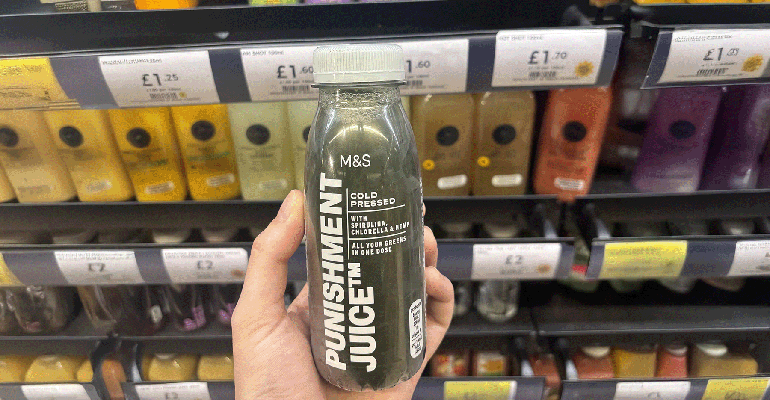
She went on to call the marketing “irresponsible” for attaching morals to the foods consumers eat and supporting the “idea that consuming vegetables is a form of penance”.
Alice Haley, a nutritionist and host of the podcast Let’s Talk Heart Health, agreed that the messaging was “harmful”, not “clever or quirky”.
She wrote: “It undermines public health efforts to promote a positive relationship with food and risks harming people already struggling with disordered eating.”
Wellness sector is ‘a breeding ground for shame-based messaging’
Punishment Juice was launched in June as part of the M&S Eat Well range, which the retailer describes as its “health seal of approval” that is “only given to products that meet evidence-based criteria developed by our nutritionists and endorsed by the British Nutrition Foundation”.
The dark-green beverage contains a mix of juices (cucumber, spinach, celery, kale, aloe vera, mint, parsley, and lime) and powders (spirulina, hemp, and chlorella), and is available at over 400 stores across the UK, retailing for £3.25 per 250 ml bottle.
Lottie Unwin, founder of marketing service companies Up World and Brand Hackers, and podcast host of The Marketing Hustle, told Ingredients Network that the launch was indicative of a broader trend across the industry.
“The wellness space has become a breeding ground for shame-based messaging,” she added, pointing to “detox teas that promise to cleanse your sins, workout brands selling punishment sessions, and food brands using words like ‘sinful’ and ‘naughty’”.
“It's particularly bad in the supplement and fitness industries, where brands seem to think fear and guilt are acceptable motivational tools,” she added.
Punishment Juice ‘shows how normalised food guilt has become’ for wellness industry
Unwin said marketing that “plays on food guilt isn't the win [brands] think it is”, adding that brand teams may have become desensitised due to the gradual creep of diet culture messaging in the industry over the years.
“They're [so] surrounded with phrases like ‘guilty pleasure’ and ‘cheat day’ that ‘Punishment Juice’ probably felt normal in that context,” she said, adding that despite this supposedly being an era of body positivity and mental health awareness, “here's a major retailer literally selling the idea that your body requires punishment”.
She asked: “When a brand that sophisticated gets it this wrong, it shows how normalised food guilt has become across the entire industry. If M&S can't spot this problem, what hope do smaller brands have who won't have a legal team or as many layers of sign-off?”
Is there such a thing as bad publicity?
However, not everyone was so quick to criticise.
James Hickson, co-founder of Just Add Milk Ventures and account director of Brand Hackers, called the launch “another great example of a big brand playing into culture and zeitgeist brilliantly”, adding: “It's the sort of thing you'd expect from a scrappy scale-up looking for attention. But executed across 100s of stores nationwide.”
He said that while the product may not be the most successful in terms of sales, “it’s getting talked about, it’s driving footfall to stores, [and] it’s cementing [M&S’s] reputation as the UK’s most interesting retail brand”.
M&S did not respond to a request for comment.
Top tips to avoid shame-based messaging
Unwin offered three “fixes” for brands looking to market products with a playful edge without reinforcing harmful narratives.
- Before you launch anything wellness-related, ask one simple question: Does this make people feel better about themselves, or worse?
- True creativity in wellness marketing comes from understanding what genuinely motivates people toward positive choices.
- Test your messaging with people. If even one person flags it as potentially harmful, listen.

Get more of our news on Google
Set Ingredients Network as a 'Preferred Source' to get quicker access to the news you value.
Related news

Do the US dietary guidelines put UPFs under pressure?
10 Sep 2026
Will the US dietary guidelines change the way Americans eat, swapping ultra-processed foods for whole foods? We asked Dr Barry Popkin, renowned nutrition and obesity researcher.
Read more
Food fraud costs UK economy £2bn each year
9 Sep 2026
Food fraud is costing the UK economy up to £2 billion (€2.3 billion) every year although the food sector is more “resilient” than others, according to a recent study.
Read more
Skimpflation: An ‘unfair’ and risky approach to keeping prices low
2 Sep 2026
Consumers see skimpflation – reducing the quality of ingredients due to rising costs – as more unfair than shrinkflation, making it a risky strategy according to recent research.
Read more
NielsenIQ’s EU barometer shows Britain leading in grocery inflation
31 Aug 2026
Britain was the only country to record grocery inflation above 2%, according to NielsenIQ data that compared Europe’s five biggest grocery markets from February to May 2026.
Read more
‘Urgent gaps’ in achieving 2030 food system goals
27 Aug 2026
Global food systems are failing to meet 2030 targets across indicators including health, environment, and resilience, according to a report co-authored by the Food and Agriculture Organisation (FAO).
Read more
China beverages: Is herbal innovation the future?
20 Aug 2026
Herbal and botanical innovation in China's drinks market continues to grow, with ingredients like astragalus root, ginger, and ginseng in the spotlight – and focus shifting far beyond refreshment.
Read more
Popular barbecue staples experience sharp price increases
19 Aug 2026
The typical cost of US shoppers’ barbecue baskets has risen by 12% over the past year – the fastest annual rise in a decade, figures from The Economist show.
Read more
Beyond 'nice to have': A spotlight on US functional beverages
12 Aug 2026
Functional beverage interest in the US is gaining important ground as consumers now expect function rather than see it as "nice to have", and there are clear market gaps for growth, according to Spate.
Read more
Manam Chocolate aims to bring premium Indian cacao to 'the world stage'
11 Aug 2026
Craft chocolate brand Manam Chocolate is investing in local expansion and supply chain innovation throughout India as it works to build out the premium reputation of its locally produced cacao products.
Read more
Digital twin technology gains ground in food manufacturing
6 Aug 2026
Food and beverage companies are increasingly turning to digital twins to optimise and automate manufacturing processes, but opportunities stretch far beyond this, say experts.
Read more