
Ingredients Categories
Finished Products
Finished Food Categories
- Bakery
- Beverages / Juices
- Cereal and grain products
- Confectionery
- Cooking Fats & Oils
- Dairy
- Egg products
- Fruits & Vegetables
- Infant & Baby food
- Meat, Poultry & Fish
- Nuts & Seeds products
- Other Finished Food Categories
- Pet Food
- Plant-based foods
- Prepared foods
- Sauces & Seasonings
- Sweet & Savoury Spreads
Specialised Finished Products
- Bee products
- Biotic products
- Dietary supplements
- Energy drinks
- Functional beverages
- Functional confectionery
- Functional food
- Functional powders
- Meal replacement products
- Nutricosmetics
- Other Specialised Finished Products
- Pet Dietary Supplements
- Pharma and OTC products
- Protein products
- Sugar replacers / Sweeteners
Health & Wellness Areas
Delivery Formats
Operations & Services
- 3D printing
- Analysis/ Testing
- Auditing & certifications
- Blending & mixing
- Bottling
- Certification
- Clinical trials
- Co-packing
- Coating
- Consulting
- Contract manufacturing
- Drying
- Electrospinning
- Encapsulating
- Enzymatic processing
- Extracting
- Extrusion
- Fat structuring
- Fermentation
- Filling
- Flavour development
- Freeze drying
- Granulating/ grinding/ milling / mixing
- High-pressure processing
- Labelling
- Other Operations & Services
- Packaging
- Packet filling
- Pasturising
- Quality assurance
- Saccharification
- Shear cell processing
- Spray drying
- Sterilisation
- Storage & Logistics
- Tabletting
- Toasting / roasting
- Ultra-high temperature processing
News
Dog food startup teams up with Harvard to accelerate AI-driven pet nutrition
Natasha Spencer-Jolliffe, Freelance Journalist 19 May 2025A premium dog food startup is teaming up with Harvard to enhance its artificial intelligence (AI) platform and accelerate pet nutrition product development.

In April, PawCo Foods – which claims to be the first plant-based dog food brand using AI technology to improve the nutrition and palatability of its products – announced the strategic partnership with Harvard Data Analytics Group (HDAG), a non-profit student organisation at Harvard College.
The collaboration is hoped to accelerate the development of PawCo's new product line, fully generated by its existing AI platform and verified by board-certified animal nutritionists, to deliver the healthiest pet food in the industry.
In doing so, the company hopes to disrupt the pet food industry and “end the dominance of unhealthy options from established players”.
Using AI to accelerate pet food formulations
PawCo strives to create healthy, tasty, fresh, and balanced meals, entirely generated by its AI platform. Designed for dogs at all life stages, its products are designed to exceed standards set by the Association of American Feed Control Officials (AAFCO).
PawCo’s proprietary AI systems analyse complex nutritional datasets. Its AI-based technology plays a vital role in its R&D process, helping the company to optimise its recipes for nutritional completeness, taste, digestibility, and ingredient quality.
AI also enables the brand to quickly bring new novel developments to market, including personalised feeding experiences for dogs of all sizes, ages, and lifestyles.
Leveraging its data-driven methodology, PawCo developed 11 nutritional formulations in two years – a feat it said typically takes traditional pet food companies 10 years to achieve.
The brand has formulated its recipes to be rich in protein, low in fat, and contain all essential amino acids, vitamins, and minerals, along with fresh fruits and vegetables.
“PawCo’s vision is to create a healthier and happier generation of dogs through better food, made more accessible by lower costs,” said Dr Mahsa Vazin, founder and CEO of PawCo.
Advancing AI to progress pet food formulations
Using PawCo’s existing AI platform, HDAG will help the brand improve its technology’s capabilities, including ingredient selection, nutritional modelling, and product development.
PawCo hopes these advancements will spur further high-performing and scientifically backed dog nutrition products to meet increasing consumer demand.
“We are beyond excited to work with the brilliant minds at Harvard to make that possible. Their passion for innovation and data science perfectly complements our mission to deliver the healthiest, most sustainable meals to dogs everywhere – more efficiently and intelligently than ever before,” Vazin added.
By advancing PawCo’s AI platform, HDAG said its contribution will help create smarter and more sustainable dog nutrition.
“Our core mission is leveraging AI and data to disrupt different industries, so it is incredibly exciting to partner with companies like PawCo who want to leverage data and AI technology to make the world a better place for our lovely companions,” said HDAG CEO Carlos Luz.
AI: An increasingly prominent tool in pet food development
Increasingly, AI is becoming a prominent tool in pet food development.
AI was a core theme at Petfood Forum 2025, a series of events exclusively for the global pet food manufacturing industry. The technology’s presence is growing in product development, trend predictions, consumer engagement, and personalised pet nutrition plans.
In 2025, the pet food market revenue is expected to reach $158.42 billion (€140 bn). A growing market, this figure is expected to rise annually by 5.79% between 2025 and 2030.
Simultaneously, AI has a growing and innovative presence in the food technology sector, which is anticipated to be worth $27.73 billion (€24.5 bn) by 2029.

Get more of our news on Google
Set Ingredients Network as a 'Preferred Source' to get quicker access to the news you value.
Related news

M&S launches own-brand pet food range
11 Sep 2026
UK retailer Marks & Spencer has launched its own-brand pet food line Paws & Pals – a well-timed and strategic move that will appeal to loyal shoppers, says a marketing expert.
Read more
Do the US dietary guidelines put UPFs under pressure?
10 Sep 2026
Will the US dietary guidelines change the way Americans eat, swapping ultra-processed foods for whole foods? We asked Dr Barry Popkin, renowned nutrition and obesity researcher.
Read more
Food fraud costs UK economy £2bn each year
9 Sep 2026
Food fraud is costing the UK economy up to £2 billion (€2.3 billion) every year although the food sector is more “resilient” than others, according to a recent study.
Read more
Kellogg accelerates work to remove artificial colours from all US cereals
3 Sep 2026
WK Kellogg has announced an accelerated timeline to eliminate all artificial colours and the chemical preservative, BHT, across its full US portfolio of cereals and cereal packaging.
Read more
‘Urgent gaps’ in achieving 2030 food system goals
27 Aug 2026
Global food systems are failing to meet 2030 targets across indicators including health, environment, and resilience, according to a report co-authored by the Food and Agriculture Organisation (FAO).
Read more
Chimac’s fusion sauces bring Korean flavours to Europe
25 Aug 2026
Irish sauce brand Chimac is tapping into Korea’s culinary traditions, bringing its flavours and products to European consumers who want a taste of K-food.
Read more
Savoury protein snacks shake up the on-the-go market
10 Aug 2026
Sweet flavours have dominated the high-protein snack category but savoury snacks, such as cheese bars and meat sticks, can appeal to health-conscious consumers.
Read more
Nestlé invests in regeneratively farmed wheat for KitKat
5 Aug 2026
Nestlé will pay a premium for Wildfarmed’s regeneratively farmed wheat but the CPG remains reticent to promote the move on packs of its KitKat bars.
Read more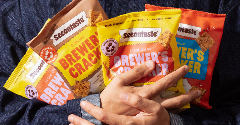
How Secon Taste is putting upcycled snacks on shelves
4 Aug 2026
Hungarian zero-waste startup Secon Taste is turning surplus food into upcycled snacks such as fibre-packed granola, instant porridge, and a circular coffee-tasting box.
Read more
Codex sets global thresholds for ‘may contain’ labels
3 Aug 2026
Codex Alimentarius has adopted its first global guidance on when to use “may contain” allergen warnings, setting thresholds intended to stop the label being used as blanket legal cover.
Read more