
Ingredients Categories
Finished Products
Finished Food Categories
- Bakery
- Beverages / Juices
- Cereal and grain products
- Confectionery
- Cooking Fats & Oils
- Dairy
- Egg products
- Fruits & Vegetables
- Infant & Baby food
- Meat, Poultry & Fish
- Nuts & Seeds products
- Other Finished Food Categories
- Pet Food
- Plant-based foods
- Prepared foods
- Sauces & Seasonings
- Sweet & Savoury Spreads
Specialised Finished Products
- Bee products
- Biotic products
- Dietary supplements
- Energy drinks
- Functional beverages
- Functional confectionery
- Functional food
- Functional powders
- Meal replacement products
- Nutricosmetics
- Other Specialised Finished Products
- Pet Dietary Supplements
- Pharma and OTC products
- Protein products
- Sugar replacers / Sweeteners
Health & Wellness Areas
Delivery Formats
Operations & Services
- 3D printing
- Analysis/ Testing
- Auditing & certifications
- Blending & mixing
- Bottling
- Certification
- Clinical trials
- Co-packing
- Coating
- Consulting
- Contract manufacturing
- Drying
- Electrospinning
- Encapsulating
- Enzymatic processing
- Extracting
- Extrusion
- Fat structuring
- Fermentation
- Filling
- Flavour development
- Freeze drying
- Granulating/ grinding/ milling / mixing
- High-pressure processing
- Labelling
- Other Operations & Services
- Packaging
- Packet filling
- Pasturising
- Quality assurance
- Saccharification
- Shear cell processing
- Spray drying
- Sterilisation
- Storage & Logistics
- Tabletting
- Toasting / roasting
- Ultra-high temperature processing
News
Fairtrade releases new living income prices for farmers
Natasha Spencer-Jolliffe, Freelance Journalist 8 Jun 2026Cocoa farmers will see Living Income Reference Prices increase in the new harvest season, after non-profit Fairtrade’s extensive year-long industry review.
Fairtrade has published its revised Living Income Reference Prices (LIRP). The new LIRPs for cocoa in Côte d’Ivoire and Ghana will be introduced during the new harvest season, beginning in autumn 2026. The two West African countries are the world's largest cocoa producers, accounting for two-thirds of global cocoa output.
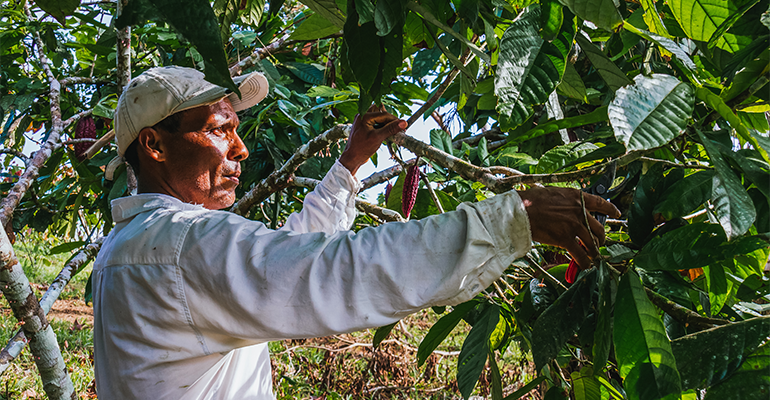
In Côte d’Ivoire, the new LIRPs are 1,758 CFA francs per kilo (€2.68), a 47% increase from the current 1,200 CFA francs (€1.82) per kilo farmgate price. In Ghana, the price is 45.40 cedi per kilo (€3.40) at the applied exchange rate, 10% higher than the current Ghanaian farmgate price of 41.40 cedi (€3.09).
How living income reference prices contribute to a fair wage
LIRPs refer to the prices a typical cocoa-farming household needs to earn a living income share, in proportion to the time they dedicate to their crop sales. The price is one element of farmers’ income, contributing to their overall livelihood. Total living incomes depend on a combination of better prices, improved productivity, climate resilience and opportunities for income diversification.
On-the-ground realities and factors, such as farm size, family labour, the impacts of climate change and the rate of adoption of good agricultural practices, are key to defining a price that reflects the conditions and needs of cocoa farmers.
“The updated LIRPs are intended to provide a clear and realistic benchmark for the cocoa price needed for farming households to move towards a living income,” Susanne Boetekees, director of policy and sustainable sourcing at Fairtrade Netherlands, told Ingredients Network.
The prices are voluntary benchmarks rather than mandatory. “They are designed to guide companies that want to contribute more meaningfully to closing income gaps for farmer households,” said Boetekees.
A farmer’s reality
Unstable and unpredictable prices make it difficult for farmers to plan and invest in introducing more sustainable and resilient farming methods that help protect their incomes and futures. Introducing new LIRPs is designed to provide more reliability during market volatility.
“The updated model better reflects the actual realities of cocoa farming households in Ghana and Côte d’Ivoire, including the fact that many households rely on multiple income sources alongside cocoa,” said Boetekees.
Questions remain about the tangible impact these revised prices will have on farmers’ livelihoods. “Whether the prices go far enough will ultimately depend on how widely and meaningfully they are applied in sourcing practices, and whether they are combined with broader long-term support for farming households, such as Fairtrade’s Living Income programme,” Boetekees added.
Reviewing farmer realities and market perspectives
Fairtrade last increased LIRP prices in January 2025, which subsequently prompted discussions about how the non-profit had calculated those prices. Stakeholders considered whether the benchmark should reflect many cocoa-farming households’ current realities, including low yields and small farm sizes, or be based on more viable farming conditions that farmers could realistically achieve with the right support and investment.
There were also questions about whether the model should primarily reflect the situation of Fairtrade farming households or serve as a broader sector benchmark.
In response, Fairtrade launched a 12-month review of its cocoa LIRP model, working with farmer organisations, companies, researchers and civil society groups. The Expert Advisory Committee (EAC) provided technical input and advice during the review, while final decisions on the updated model were taken within the Fairtrade system.
During the review process, global cocoa prices dropped from highs of over $10,000 (€8,628) per tonne in late 2024 to approximately $3,400 (€2,934) per tonne in April 2026. “This means farmers are even more vulnerable than they were a year ago,” said a spokesperson for Fairtrade. Closing the living income gap to enable cocoa farmers to earn a decent living from cocoa is as important, but harder to achieve.
“The result is an updated model that more clearly reflects the realities and economics of cocoa farming households, based on available data and stakeholder input,” said Boetekees.
Progressing protection for cocoa farmers’ living conditions
“The updated LIRPs are intended to support a more transparent and practical discussion across the cocoa sector about what responsible sourcing means in practice,” Boetekees added.
The review also reinforces the principle that achieving living incomes is a shared responsibility across the supply chain. Farmer households contribute through their labour and farm management, while buyers, companies, governments and civil society all play a role in creating the conditions for more sustainable livelihoods.
Fairtrade also emphasises that pricing alone is not sufficient. Long-term progress towards living incomes also depends on investment in productivity, strong cooperatives, climate resilience, income diversification and stable trading relationships.
“The updated LIRP model is therefore intended not simply as a pricing tool, but as a practical framework for translating living income commitments into sourcing approaches that are more realistic, transparent and accountable,” Boetekees added.
In addition to its LIRPs for Côte d’Ivoire and Ghana, Fairtrade plans to develop a cocoa LIRP for Peru, expected in early 2027.

Get more of our news on Google
Set Ingredients Network as a 'Preferred Source' to get quicker access to the news you value.
Related news

Do the US dietary guidelines put UPFs under pressure?
10 Sep 2026
Will the US dietary guidelines change the way Americans eat, swapping ultra-processed foods for whole foods? We asked Dr Barry Popkin, renowned nutrition and obesity researcher.
Read more
Health and wellness engagement matures across Middle East and Africa
4 Sep 2026
Many consumers in the Middle East and Africa are now proactively engaged in health and wellness, looking to integrate better habits and products into their daily lives, say experts.
Read more
Skimpflation: An ‘unfair’ and risky approach to keeping prices low
2 Sep 2026
Consumers see skimpflation – reducing the quality of ingredients due to rising costs – as more unfair than shrinkflation, making it a risky strategy according to recent research.
Read more
‘Urgent gaps’ in achieving 2030 food system goals
27 Aug 2026
Global food systems are failing to meet 2030 targets across indicators including health, environment, and resilience, according to a report co-authored by the Food and Agriculture Organisation (FAO).
Read more
Seven-Eleven uses microbial testing tech to extend katsudon shelf life
26 Aug 2026
Japanese retail company Seven-Eleven has improved its factory’s microbial environment to keep comfort-food staple, katsudon, fresher for longer.
Read more
Chimac’s fusion sauces bring Korean flavours to Europe
25 Aug 2026
Irish sauce brand Chimac is tapping into Korea’s culinary traditions, bringing its flavours and products to European consumers who want a taste of K-food.
Read more
Global demand for instant noodles continues to rise
24 Aug 2026
Global demand for instant noodles reached 124.21 billion servings last year, representing a 0.7% year-on-year increase – or 900 million extra servings.
Read more
Popular barbecue staples experience sharp price increases
19 Aug 2026
The typical cost of US shoppers’ barbecue baskets has risen by 12% over the past year – the fastest annual rise in a decade, figures from The Economist show.
Read more
Hot NPD: Nissin launches first cold-water Cup Noodles
18 Aug 2026
Nissin is taking one of Japan’s most iconic instant meals in a completely new direction with the launch of the first cold water-only Cup Noodles in the brand’s 55-year history.
Read more
Manam Chocolate aims to bring premium Indian cacao to 'the world stage'
11 Aug 2026
Craft chocolate brand Manam Chocolate is investing in local expansion and supply chain innovation throughout India as it works to build out the premium reputation of its locally produced cacao products.
Read more