
Ingredients Categories
Finished Products
Finished Food Categories
- Bakery
- Beverages / Juices
- Cereal and grain products
- Confectionery
- Cooking Fats & Oils
- Dairy
- Egg products
- Fruits & Vegetables
- Infant & Baby food
- Meat, Poultry & Fish
- Nuts & Seeds products
- Other Finished Food Categories
- Pet Food
- Plant-based foods
- Prepared foods
- Sauces & Seasonings
- Sweet & Savoury Spreads
Specialised Finished Products
- Bee products
- Biotic products
- Dietary supplements
- Energy drinks
- Functional beverages
- Functional confectionery
- Functional food
- Functional powders
- Meal replacement products
- Nutricosmetics
- Other Specialised Finished Products
- Pet Dietary Supplements
- Pharma and OTC products
- Protein products
- Sugar replacers / Sweeteners
Health & Wellness Areas
Delivery Formats
Operations & Services
- 3D printing
- Analysis/ Testing
- Auditing & certifications
- Blending & mixing
- Bottling
- Certification
- Clinical trials
- Co-packing
- Coating
- Consulting
- Contract manufacturing
- Drying
- Electrospinning
- Encapsulating
- Enzymatic processing
- Extracting
- Extrusion
- Fat structuring
- Fermentation
- Filling
- Flavour development
- Freeze drying
- Granulating/ grinding/ milling / mixing
- High-pressure processing
- Labelling
- Other Operations & Services
- Packaging
- Packet filling
- Pasturising
- Quality assurance
- Saccharification
- Shear cell processing
- Spray drying
- Sterilisation
- Storage & Logistics
- Tabletting
- Toasting / roasting
- Ultra-high temperature processing
News
Gatorade switches from artificial to natural colours
Natasha Spencer-Jolliffe, Freelance Journalist 27 May 2026PepsiCo-owned brand Gatorade is removing artificial colours from its powder sticks and three ready-to-drink flavours, reformulating them using colours from fruits and vegetables.
Gatorade announced this spring plans to remove all artificial colours from its full range of powder sticks. Then, in the autumn, three of the brand’s ready-to-drink (RTD) flavours in Gatorade Thirst Quencher and Gatorade Zero – Fruit Punch, Lemon Lime and Orange – will be reformulated to be free from synthetic colours.
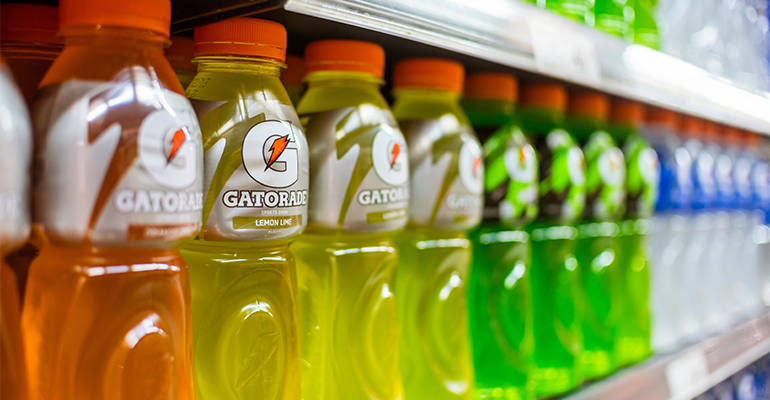
Instead, the brand’s range will use colours from fruits and vegetables, formulated to retain the bold, vibrant shades consumers recognise and expect.
“We’re on a journey to remove artificial colours from our product portfolio while maintaining the bold Gatorade colour people know and love,” said Mike Del Pozzo, president of PepsiCo Beverages US.
A bold and vibrant move
While making the change from artificial to natural colouration in food and drink products is proving popular, achieving exact colour may be challenging.
Synthetic dyes are generally synthesised from petrochemicals and are generally stable and can provide vibrant colours.
Some food and beverage brands will use fruits, vegetables and plants free of genetically modified organisms (GMOs) to shift from artificial to natural colours in their products, relying on the natural pigments in these raw materials.
Food and beverage manufacturers will need to modify their operating processes to optimise production conditions and achieve realistic colours, providing an effective – and natural – solution.
Results will therefore depend on the exact product, the target shade in the formulation, processing and storage conditions, and shelf life.
Managing consumer expectations
With today’s consumers valuing natural ingredients, processes and manufacturing practices, slight variations in shade may therefore not be a deal-breaker for shoppers at the tills.
If an exact colour match isn't possible, suppliers can typically achieve a very similar shade.
Communication strategies and marketing messages, however, may be pivotal in maintaining consumer trust in household names given the differences in colours, especially when shoppers are used to purchasing products featuring familiar yet artificial colours. For suppliers, providing clear, honest advice on colour selection and formulation tailored to their specific requirements is vital.
Natural, not novel: Retaining brand appeal and sales
Brands may use blends to achieve the target shade and ensure good stability. A mix of orange and maroon red, for example, might be the best way to get a vibrant fire engine red.
Suppliers may also recommend formulation adjustments, such as tweaks to the base product’s pH level, to help ensure the colour is bright and stable.
Moving away from artificial colours to natural shades gives brands the opportunity to share stories about how their colours are made, too. Brands may use edible concentrates processed with physical methods and water, which is likely to resonate strongly with shoppers.

Get more of our news on Google
Set Ingredients Network as a 'Preferred Source' to get quicker access to the news you value.
Related news

Do the US dietary guidelines put UPFs under pressure?
10 Sep 2026
Will the US dietary guidelines change the way Americans eat, swapping ultra-processed foods for whole foods? We asked Dr Barry Popkin, renowned nutrition and obesity researcher.
Read more
Health and wellness engagement matures across Middle East and Africa
4 Sep 2026
Many consumers in the Middle East and Africa are now proactively engaged in health and wellness, looking to integrate better habits and products into their daily lives, say experts.
Read more
Skimpflation: An ‘unfair’ and risky approach to keeping prices low
2 Sep 2026
Consumers see skimpflation – reducing the quality of ingredients due to rising costs – as more unfair than shrinkflation, making it a risky strategy according to recent research.
Read more
‘Urgent gaps’ in achieving 2030 food system goals
27 Aug 2026
Global food systems are failing to meet 2030 targets across indicators including health, environment, and resilience, according to a report co-authored by the Food and Agriculture Organisation (FAO).
Read more
Seven-Eleven uses microbial testing tech to extend katsudon shelf life
26 Aug 2026
Japanese retail company Seven-Eleven has improved its factory’s microbial environment to keep comfort-food staple, katsudon, fresher for longer.
Read more
Chimac’s fusion sauces bring Korean flavours to Europe
25 Aug 2026
Irish sauce brand Chimac is tapping into Korea’s culinary traditions, bringing its flavours and products to European consumers who want a taste of K-food.
Read more
Global demand for instant noodles continues to rise
24 Aug 2026
Global demand for instant noodles reached 124.21 billion servings last year, representing a 0.7% year-on-year increase – or 900 million extra servings.
Read more
Popular barbecue staples experience sharp price increases
19 Aug 2026
The typical cost of US shoppers’ barbecue baskets has risen by 12% over the past year – the fastest annual rise in a decade, figures from The Economist show.
Read more
Hot NPD: Nissin launches first cold-water Cup Noodles
18 Aug 2026
Nissin is taking one of Japan’s most iconic instant meals in a completely new direction with the launch of the first cold water-only Cup Noodles in the brand’s 55-year history.
Read more
Manam Chocolate aims to bring premium Indian cacao to 'the world stage'
11 Aug 2026
Craft chocolate brand Manam Chocolate is investing in local expansion and supply chain innovation throughout India as it works to build out the premium reputation of its locally produced cacao products.
Read more