
Ingredients Categories
Finished Products
Finished Food Categories
- Bakery
- Beverages / Juices
- Cereal and grain products
- Confectionery
- Cooking Fats & Oils
- Dairy
- Egg products
- Fruits & Vegetables
- Infant & Baby food
- Meat, Poultry & Fish
- Nuts & Seeds products
- Other Finished Food Categories
- Pet Food
- Plant-based foods
- Prepared foods
- Sauces & Seasonings
- Sweet & Savoury Spreads
Specialised Finished Products
- Bee products
- Biotic products
- Dietary supplements
- Energy drinks
- Functional beverages
- Functional confectionery
- Functional food
- Functional powders
- Meal replacement products
- Nutricosmetics
- Other Specialised Finished Products
- Pet Dietary Supplements
- Pharma and OTC products
- Protein products
- Sugar replacers / Sweeteners
Health & Wellness Areas
Delivery Formats
Operations & Services
- 3D printing
- Analysis/ Testing
- Auditing & certifications
- Blending & mixing
- Bottling
- Certification
- Clinical trials
- Co-packing
- Coating
- Consulting
- Contract manufacturing
- Drying
- Electrospinning
- Encapsulating
- Enzymatic processing
- Extracting
- Extrusion
- Fat structuring
- Fermentation
- Filling
- Flavour development
- Freeze drying
- Granulating/ grinding/ milling / mixing
- High-pressure processing
- Labelling
- Other Operations & Services
- Packaging
- Packet filling
- Pasturising
- Quality assurance
- Saccharification
- Shear cell processing
- Spray drying
- Sterilisation
- Storage & Logistics
- Tabletting
- Toasting / roasting
- Ultra-high temperature processing
News
How healthy are plant-based drinks in China?
Natasha Spencer-Jolliffe, Freelance Journalist 28 Jul 2023
Researchers studying the nutritional content of plant-based protein drinks recommend consumers closely observe nutrition facts and ingredient information.
Last month, scientists at the Yangtze Delta Region Institute of Tsinghua University in China published the results of their study into the nutrient composition of plant protein beverages in its domestic digital sector.

Analysing existing plant protein drinks
The researchers examined 251 plant protein beverages, including coconut, soy, oats, walnut, almond, peanut, rice, other beans, and mixed nuts. They assessed these according to the commercial packaging’s nutrition labels and the information displayed on retailer websites.
They found that except for soy, plant protein beverages typically had low protein content, and cereal beverages indicated relatively high energy and carbohydrate levels. All plant protein beverages had low sodium content. Furthermore, the researchers found that the vitamins and minerals in the examined plant protein beverages displayed an “extremely low” fortification rate of only 13.1%.
The results showed considerable variation in the nutritional composition of plant protein beverages. Therefore, the researchers recommend that consumers pay more attention to nutrition facts and ingredient information when selecting plant-based drinks.
Chinese consumers’ perceptions and uptake
Dairy alternative protein drinks formulated with plants are rising in popularity in the beverages sector. Their growing favour is due to various influences, including the prevalence of lactose intolerance and veganism, along with a proliferation of health claims and raised environmental consciousness as shoppers seek out products with health, wellbeing, and sustainability pledges.
“China’s alternative dairy sector is rapidly expanding as food and beverage industry stakeholders increasingly understand that tackling the twin challenges of rising population growth and diminishing natural resources requires making protein production more efficient and secure by decoupling it from industrial animal agriculture,” Mirte Gosker, managing director of the Good Food Institute APAC, Asia’s leading alternative protein think tank, told Ingredients Network.
Plant-based milk is considered the growth engine of the broader global milk category in the beverage space, Gosker said. In the US, milk has steadily declined since 1975, reaching an all-time low in 2021, with consumption at about 16 gallons per person a year, the USDA reported.
However, while interest in cow’s milk is down in many key markets worldwide, Gosker said plant-based milk is ascendant, and most of this demand is coming from China and other parts of Asia-Pacific.
Plant-based milk market in China
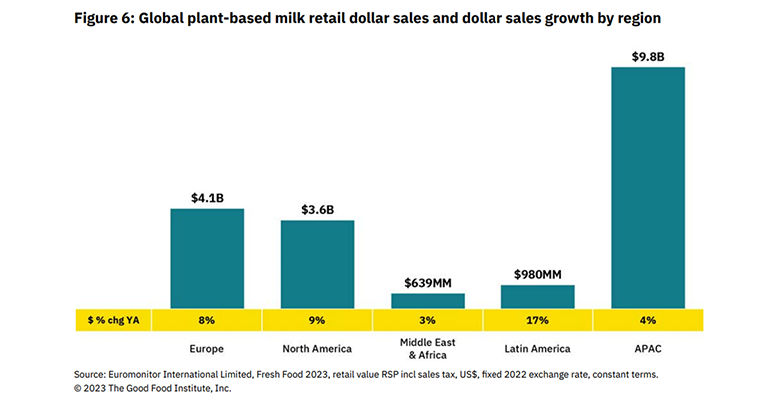
The APAC plant-based milk retail sales market has hit $9.8 billion, the Good Food Institute’s State of the Industry Report 2022 states, citing figures from Euromonitor International Limited, Fresh Food 2023. Sales in the region are more than double its closest rival, Europe, which has $4.1 billion in sales.
 [Source]
“Soy milk has long been a key part of China's food culture, with over half of Chinese consumers consuming plant protein drinks a few times a week or every day,” said Gosker.
The plant-based milk category also continues to diversify, with Oatly, Formo, New Culture, and Better Dairy examples of dairy alternative brands releasing new formulations on to the retail market.
“Now, GFI’s data shows that plant-based beverages from oat and almonds drive over half of all regional plant-based milk sales in APAC,” added Gosker.
Additional alternative dairy products, such as plant-based ice cream and plant-based yoghurt, are undergoing similar growth in the APAC region, partly due to consumers’ familiarity with plant-based milks.
Communicating plant-based benefits
Marketing and claims play a vital role in conveying the perceived health benefits of plant proteins.
“One of the biggest selling points for plant-based milk is that lactose malabsorption (LM), which is the inability to digest lactose, affects nearly 100% of people in East Asia,” said Gosker. Many LM sufferers are lactose intolerant and experience gastrointestinal symptoms after consuming lactose, such as bloating and diarrhoea, making them a receptive market for plant-based dairy products, Gosker added.
“This predisposition to avoid animal-based milk creates an enormous opportunity for innovative plant-based beverage producers, but only if they can develop products that exceed customer expectations on taste, price, nutrition, and affordability,” Gosker continued.
 Pictured: Various plant-based milks | © AdobeStock/beats_
Recommendations for getting the messaging right
Manufacturers must accurately communicate the specific plant-based protein drink’s composition and health benefits for their beverages. Chinese consumers have expressed a strong desire to try products they perceive as innovative or deliver added values not previously available to them.
“Brands would be wise to lean more heavily into this angle by ramping up the nutritional and taste benefits of plant-based beverages to the point where they are the clear winner in all metrics that matter to consumers,” said Gosker.
Producers can allocate resources to accelerate technological advancements that increase product quality and drive down costs, Gosker said, prompting further novel product developments that can create a glide path to widespread adoption.
“Additionally, it’s important to remember that, unlike in the West, there is not a deep history of cow’s milk consumption in East Asian cultures,” said Gosker.
“So while plant-based products absolutely must outperform animal-based dairy on taste and price to drive mainstream sales in China… many local consumers simply view plant-based milk as a natural part of a healthy lifestyle rather than a replacement.”

Get more of our news on Google
Set Ingredients Network as a 'Preferred Source' to get quicker access to the news you value.
Related news

Do the US dietary guidelines put UPFs under pressure?
10 Sep 2026
Will the US dietary guidelines change the way Americans eat, swapping ultra-processed foods for whole foods? We asked Dr Barry Popkin, renowned nutrition and obesity researcher.
Read more
Food fraud costs UK economy £2bn each year
9 Sep 2026
Food fraud is costing the UK economy up to £2 billion (€2.3 billion) every year although the food sector is more “resilient” than others, according to a recent study.
Read more
Skimpflation: An ‘unfair’ and risky approach to keeping prices low
2 Sep 2026
Consumers see skimpflation – reducing the quality of ingredients due to rising costs – as more unfair than shrinkflation, making it a risky strategy according to recent research.
Read more
NielsenIQ’s EU barometer shows Britain leading in grocery inflation
31 Aug 2026
Britain was the only country to record grocery inflation above 2%, according to NielsenIQ data that compared Europe’s five biggest grocery markets from February to May 2026.
Read more
‘Urgent gaps’ in achieving 2030 food system goals
27 Aug 2026
Global food systems are failing to meet 2030 targets across indicators including health, environment, and resilience, according to a report co-authored by the Food and Agriculture Organisation (FAO).
Read more
China beverages: Is herbal innovation the future?
20 Aug 2026
Herbal and botanical innovation in China's drinks market continues to grow, with ingredients like astragalus root, ginger, and ginseng in the spotlight – and focus shifting far beyond refreshment.
Read more
Popular barbecue staples experience sharp price increases
19 Aug 2026
The typical cost of US shoppers’ barbecue baskets has risen by 12% over the past year – the fastest annual rise in a decade, figures from The Economist show.
Read more
Beyond 'nice to have': A spotlight on US functional beverages
12 Aug 2026
Functional beverage interest in the US is gaining important ground as consumers now expect function rather than see it as "nice to have", and there are clear market gaps for growth, according to Spate.
Read more
Manam Chocolate aims to bring premium Indian cacao to 'the world stage'
11 Aug 2026
Craft chocolate brand Manam Chocolate is investing in local expansion and supply chain innovation throughout India as it works to build out the premium reputation of its locally produced cacao products.
Read more
Digital twin technology gains ground in food manufacturing
6 Aug 2026
Food and beverage companies are increasingly turning to digital twins to optimise and automate manufacturing processes, but opportunities stretch far beyond this, say experts.
Read more