
Ingredients Categories
Finished Products
Finished Food Categories
- Bakery
- Beverages / Juices
- Cereal and grain products
- Confectionery
- Cooking Fats & Oils
- Dairy
- Egg products
- Fruits & Vegetables
- Infant & Baby food
- Meat, Poultry & Fish
- Nuts & Seeds products
- Other Finished Food Categories
- Pet Food
- Plant-based foods
- Prepared foods
- Sauces & Seasonings
- Sweet & Savoury Spreads
Specialised Finished Products
- Bee products
- Biotic products
- Dietary supplements
- Energy drinks
- Functional beverages
- Functional confectionery
- Functional food
- Functional powders
- Meal replacement products
- Nutricosmetics
- Other Specialised Finished Products
- Pet Dietary Supplements
- Pharma and OTC products
- Protein products
- Sugar replacers / Sweeteners
Health & Wellness Areas
Delivery Formats
Operations & Services
- 3D printing
- Analysis/ Testing
- Auditing & certifications
- Blending & mixing
- Bottling
- Certification
- Clinical trials
- Co-packing
- Coating
- Consulting
- Contract manufacturing
- Drying
- Electrospinning
- Encapsulating
- Enzymatic processing
- Extracting
- Extrusion
- Fat structuring
- Fermentation
- Filling
- Flavour development
- Freeze drying
- Granulating/ grinding/ milling / mixing
- High-pressure processing
- Labelling
- Other Operations & Services
- Packaging
- Packet filling
- Pasturising
- Quality assurance
- Saccharification
- Shear cell processing
- Spray drying
- Sterilisation
- Storage & Logistics
- Tabletting
- Toasting / roasting
- Ultra-high temperature processing
News
Supermarkets innovate with private label plant-based ranges
Simon Pitman, Freelance Journalist 9 Jan 2024
Plant-based product ranges are an important part of retailers’ private label innovation efforts – and represent an important way for supermarkets to reduce their environmental impact.
At Fi Europe, a diverse selection of industry professionals came together to discuss how retailers are driving sustainability through own label plant-based foods. The panel discussion included Martin Ranninger, co-director at V Label International, Dirk Liebenberg, senior project manager at ProVeg International, Indy Kaur, founder of Plant Futures and Michael Janzr, buyer of ecology conscious nutrition at Lidl.

Lidl aligns its efforts to EAT Lancet Commission policy
When it comes to broad sustainability measures, Janzr pointed to how Lidl has pegged its sustainable food policy to the Planetary Health Diet, which was established by the EAT Lancet Commission in 2019, mapping out ways the planet can sustainably feed a population of 10 million people by 2050.
“The Planetary Health Diet is mainly plant-based with a small part being animal-based,” said Janzr. “But you look at the environmental footprint of animal-based food, and 75% of land use is devoted to animal food production, accounting for almost 70% of the CO2 emissions. So, if you increase the intake of plant-based foods, it is going to have a more sustainably overall.”
Liebenberg agreed with this, adding his thoughts about how retailers can improve their environmental footprints through plant-based foods.
“When you look at the whole picture, the products that you sell make the biggest chunk of your climate footprint,” said Liebenberg. “So, if we can promote more plant-based eating, we can make a big impact or sustainability.”
Omnivores: The next generation plant-based consumer
Liebenberg pointed to a study that ProVeg International recently commissioned in 10 different European countries, highlighting what consumers are looking for when it comes to plant-based foods. The survey results showed that consumers are picking up on the trend for plant-based foods as meat alternatives, backed by the expectation that those offerings need to be healthy, while taste and affordability were the other two important elements.
The survey results reflected the fact that these expectations were not always being met; this was also illustrated by the fact that in the past two years, sales of plant-based foods have stagnated in the two biggest European markets, Germany and the UK.
Kaur also pointed to research carried out by Plant Futures, which shows how the expectations and beliefs of the all-important omnivore consumers are shifting as attitude to plant-based foods evolve.
“Omnivores are open to reducing their meat consumption and eating more plant-based foods,” said Kaur. “They have this belief that meat is nutritionally necessary, but a flexitarian doesn't believe that as much. What we now need to do is really start thinking about how we attract this new type of omnivore consumer, essentially the next generation plant-based consumer, and focus on influencing their behavior.”
Private label plant-based brands are ‘here to stay’
On the topic of opportunities in the plant-based foods category, the panelists all agreed that a lot of the potential can be fulfilled by private label companies, who are in a strong position to take advantage of the complete supply chain.
Ranninger said that both private labels and brands were both well placed to take advantage of growing interest in plant-based foods. “Some of the first moves in the market were made by private label businesses, and they were not always the most fortunate, which does suggest that there is room for brands to step in… but I also think that private label brands are here to stay in this space and will only grow.”
Consumer trust is make or break
When it came to consumer trust, the panelists all considered this to be of vital importance, particularly with respect to sustainability and the quality of the product, while also stressing that significant work must be done to win over consumer confidence in plant-based foods.
Kaur said: “If people do not trust food, they are not going to buy it, it is as simple as that. An analysis of the EU Smart Protein Project shows us that about 40% of the population don't know if they can trust plant-based meat. If that is true, it is incredibly worrying.
“But we can learn a lot within the plant-based sector from the meat and dairy sectors, because these sectors do things very well. There is constant reassurance to win trust in farmers. Particularly with various certifications, like RSPCA-approved [Royal Society for the Prevention of Cruelty to Animals] or Red Tractor, or different types of food safety certifications. Trusted retailers can also do their part by introducing own-label plant-based foods with messaging that provides the same level of reassurance.”

Get more of our news on Google
Set Ingredients Network as a 'Preferred Source' to get quicker access to the news you value.
Related news

M&S launches own-brand pet food range
11 Sep 2026
UK retailer Marks & Spencer has launched its own-brand pet food line Paws & Pals – a well-timed and strategic move that will appeal to loyal shoppers, says a marketing expert.
Read more
Do the US dietary guidelines put UPFs under pressure?
10 Sep 2026
Will the US dietary guidelines change the way Americans eat, swapping ultra-processed foods for whole foods? We asked Dr Barry Popkin, renowned nutrition and obesity researcher.
Read more
Food fraud costs UK economy £2bn each year
9 Sep 2026
Food fraud is costing the UK economy up to £2 billion (€2.3 billion) every year although the food sector is more “resilient” than others, according to a recent study.
Read more
Kellogg accelerates work to remove artificial colours from all US cereals
3 Sep 2026
WK Kellogg has announced an accelerated timeline to eliminate all artificial colours and the chemical preservative, BHT, across its full US portfolio of cereals and cereal packaging.
Read more
‘Urgent gaps’ in achieving 2030 food system goals
27 Aug 2026
Global food systems are failing to meet 2030 targets across indicators including health, environment, and resilience, according to a report co-authored by the Food and Agriculture Organisation (FAO).
Read more
Chimac’s fusion sauces bring Korean flavours to Europe
25 Aug 2026
Irish sauce brand Chimac is tapping into Korea’s culinary traditions, bringing its flavours and products to European consumers who want a taste of K-food.
Read more
Savoury protein snacks shake up the on-the-go market
10 Aug 2026
Sweet flavours have dominated the high-protein snack category but savoury snacks, such as cheese bars and meat sticks, can appeal to health-conscious consumers.
Read more
Nestlé invests in regeneratively farmed wheat for KitKat
5 Aug 2026
Nestlé will pay a premium for Wildfarmed’s regeneratively farmed wheat but the CPG remains reticent to promote the move on packs of its KitKat bars.
Read more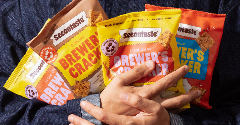
How Secon Taste is putting upcycled snacks on shelves
4 Aug 2026
Hungarian zero-waste startup Secon Taste is turning surplus food into upcycled snacks such as fibre-packed granola, instant porridge, and a circular coffee-tasting box.
Read more
Codex sets global thresholds for ‘may contain’ labels
3 Aug 2026
Codex Alimentarius has adopted its first global guidance on when to use “may contain” allergen warnings, setting thresholds intended to stop the label being used as blanket legal cover.
Read more