
Ingredients Categories
Finished Products
Finished Food Categories
- Bakery
- Beverages / Juices
- Cereal and grain products
- Confectionery
- Cooking Fats & Oils
- Dairy
- Egg products
- Fruits & Vegetables
- Infant & Baby food
- Meat, Poultry & Fish
- Nuts & Seeds products
- Other Finished Food Categories
- Pet Food
- Plant-based foods
- Prepared foods
- Sauces & Seasonings
- Sweet & Savoury Spreads
Specialised Finished Products
- Bee products
- Biotic products
- Dietary supplements
- Energy drinks
- Functional beverages
- Functional confectionery
- Functional food
- Functional powders
- Meal replacement products
- Nutricosmetics
- Other Specialised Finished Products
- Pet Dietary Supplements
- Pharma and OTC products
- Protein products
- Sugar replacers / Sweeteners
Health & Wellness Areas
Delivery Formats
Operations & Services
- 3D printing
- Analysis/ Testing
- Auditing & certifications
- Blending & mixing
- Bottling
- Certification
- Clinical trials
- Co-packing
- Coating
- Consulting
- Contract manufacturing
- Drying
- Electrospinning
- Encapsulating
- Enzymatic processing
- Extracting
- Extrusion
- Fat structuring
- Fermentation
- Filling
- Flavour development
- Freeze drying
- Granulating/ grinding/ milling / mixing
- High-pressure processing
- Labelling
- Other Operations & Services
- Packaging
- Packet filling
- Pasturising
- Quality assurance
- Saccharification
- Shear cell processing
- Spray drying
- Sterilisation
- Storage & Logistics
- Tabletting
- Toasting / roasting
- Ultra-high temperature processing
News
‘World's first’ complete dog food with cultivated meat hits EU market
David Burrows, Freelance Journalist 4 Jun 2026Italian brand Forza10 has launched a complete wet dog food that the company claims is the first commercially launched pet food containing cultivated meat.
Developed in partnership with Czech biotech company BeneMeat, Coolty Meat contains 26% cultivated meat and is formulated as a monoprotein without the use of antibiotics, hormones, or preservatives.

Launched in May, it is likely to be pitched in particular at owners who have dogs with intolerances.
“[Cultivated] meat allows us to combine high nutritional quality, digestibility, and safety in one ingredient,” said Forza10 brand representative Gianandrea Guidetti.
“Collaborating with BeneMeat has allowed us to work with an innovative ingredient that matches our emphasis on quality and a scientific approach to animal nutrition.”
Cultivated meat: ‘Rewriting the rules’ of pet nutrition
The cells for making the cultivated meat are derived from small rodents.
“The digestive physiology of domestic carnivores is optimised to metabolise the proteins and lipids found in small mammals,” the Forza10 website reads.
The rodents offer a “balanced essential amino acid profile” and “low allergenic risk”, it adds.
Posting on social media after the launch, Guidetti said the company was “rewriting the rules of pet nutrition”.
He added: “Supported by the international Nasta Pet Food [the European consortium of natural pet food manufacturers] we are proving that commercial biotechnology in pet food is a reality.
“We aren't just creating a new product; we are opening a brand-new pathway for functional, hypoallergenic, and deeply sustainable nutrition.”
Carbon study shows benefits of cultivated meat
Earlier in May, BeneMeat published a peer-reviewed life cycle assessment (LCA) showing that “cultivated meat, when produced at scale, can offer a comparable or lower environmental footprint than conventional chicken, particularly when key inputs and energy sources are optimised”.
The study, published in the International Journal of Life Cycle Assessment, quantified environmental hotspots and compared the cultivated meat from BeneMeat against conventional meats. The LCA was based on pilot-scale data and a facility producing 400 to 600kg of cultivated meat per day.
The authors, from the Czech Technical University in Prague and BeneMeat, said their findings “indicate that BeneMeat is making significant progress in its mission to produce not only economically viable but also environmentally friendly CM [cultivated meat]”.
They suggested that emissions could be lowered further through minimising the effects of key inputs such as soy protein isolate (SPI) and glucose, as well as using more renewable energy in the production facility.
Elliot Swartz, principal scientist for cultivated meat at the Good Food Institute (GFI), welcomed the findings, which show that “small-scale CM production today can have lower land use than all conventional meat production and can be competitive with conventional chicken/pork production on carbon footprint (significantly lower than beef, even dairy beef)”.
He noted that water use was similar or slightly higher for cultivated meat.
“[This] can be explained by BeneMeat's intention to sell spent media for revenue rather than recycle the water. Energy demand for CM was higher than conventional meat production, which aligns with prior work, but lower than previous cultivated LCA estimates,” he added.

Get more of our news on Google
Set Ingredients Network as a 'Preferred Source' to get quicker access to the news you value.
Related news

M&S launches own-brand pet food range
11 Sep 2026
UK retailer Marks & Spencer has launched its own-brand pet food line Paws & Pals – a well-timed and strategic move that will appeal to loyal shoppers, says a marketing expert.
Read more
Do the US dietary guidelines put UPFs under pressure?
10 Sep 2026
Will the US dietary guidelines change the way Americans eat, swapping ultra-processed foods for whole foods? We asked Dr Barry Popkin, renowned nutrition and obesity researcher.
Read more
Food fraud costs UK economy £2bn each year
9 Sep 2026
Food fraud is costing the UK economy up to £2 billion (€2.3 billion) every year although the food sector is more “resilient” than others, according to a recent study.
Read more
Kellogg accelerates work to remove artificial colours from all US cereals
3 Sep 2026
WK Kellogg has announced an accelerated timeline to eliminate all artificial colours and the chemical preservative, BHT, across its full US portfolio of cereals and cereal packaging.
Read more
‘Urgent gaps’ in achieving 2030 food system goals
27 Aug 2026
Global food systems are failing to meet 2030 targets across indicators including health, environment, and resilience, according to a report co-authored by the Food and Agriculture Organisation (FAO).
Read more
Chimac’s fusion sauces bring Korean flavours to Europe
25 Aug 2026
Irish sauce brand Chimac is tapping into Korea’s culinary traditions, bringing its flavours and products to European consumers who want a taste of K-food.
Read more
Savoury protein snacks shake up the on-the-go market
10 Aug 2026
Sweet flavours have dominated the high-protein snack category but savoury snacks, such as cheese bars and meat sticks, can appeal to health-conscious consumers.
Read more
Nestlé invests in regeneratively farmed wheat for KitKat
5 Aug 2026
Nestlé will pay a premium for Wildfarmed’s regeneratively farmed wheat but the CPG remains reticent to promote the move on packs of its KitKat bars.
Read more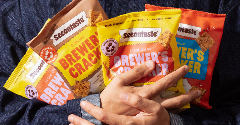
How Secon Taste is putting upcycled snacks on shelves
4 Aug 2026
Hungarian zero-waste startup Secon Taste is turning surplus food into upcycled snacks such as fibre-packed granola, instant porridge, and a circular coffee-tasting box.
Read more
Codex sets global thresholds for ‘may contain’ labels
3 Aug 2026
Codex Alimentarius has adopted its first global guidance on when to use “may contain” allergen warnings, setting thresholds intended to stop the label being used as blanket legal cover.
Read more