
Ingredients Categories
Finished Products
Finished Food Categories
- Bakery
- Beverages / Juices
- Cereal and grain products
- Confectionery
- Cooking Fats & Oils
- Dairy
- Egg products
- Fruits & Vegetables
- Infant & Baby food
- Meat, Poultry & Fish
- Nuts & Seeds products
- Other Finished Food Categories
- Pet Food
- Plant-based foods
- Prepared foods
- Sauces & Seasonings
- Sweet & Savoury Spreads
Specialised Finished Products
- Bee products
- Biotic products
- Dietary supplements
- Energy drinks
- Functional beverages
- Functional confectionery
- Functional food
- Functional powders
- Meal replacement products
- Nutricosmetics
- Other Specialised Finished Products
- Pet Dietary Supplements
- Pharma and OTC products
- Protein products
- Sugar replacers / Sweeteners
Health & Wellness Areas
Delivery Formats
Operations & Services
- 3D printing
- Analysis/ Testing
- Auditing & certifications
- Blending & mixing
- Bottling
- Certification
- Clinical trials
- Co-packing
- Coating
- Consulting
- Contract manufacturing
- Drying
- Electrospinning
- Encapsulating
- Enzymatic processing
- Extracting
- Extrusion
- Fat structuring
- Fermentation
- Filling
- Flavour development
- Freeze drying
- Granulating/ grinding/ milling / mixing
- High-pressure processing
- Labelling
- Other Operations & Services
- Packaging
- Packet filling
- Pasturising
- Quality assurance
- Saccharification
- Shear cell processing
- Spray drying
- Sterilisation
- Storage & Logistics
- Tabletting
- Toasting / roasting
- Ultra-high temperature processing
News
Beyond Meat rebrand: Bold marketing move, or messaging misstep?
David Burrows, Freelance Journalist 11 Sep 2025Beyond Meat has dropped “Meat” from its name and is focusing on shorter ingredients lists and nutrient-dense products.
The move, announced at the end of July, comes as part of a rebrand hoped to revive a company that is struggling financially and seems to have lost its touch when tapping into consumer trends, according to experts consulted by Ingredients Network.
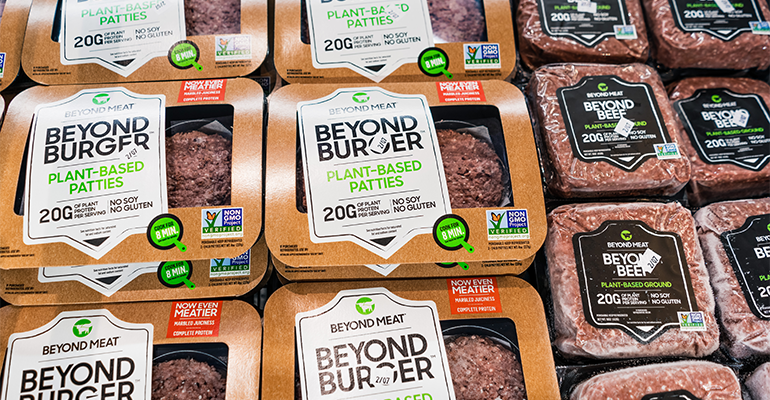
Like other plant-based meat brands, Beyond has also faced criticism over the highly processed nature of its products, which are designed to mimic meats as closely as possible.
“I think they have struggled to define the brand and are lacking consistent messaging,” said sustainability marketing consultant Gill Wilson, who is also an adjunct professor at IE Business School, in Madrid. “I feel they don’t know who they are targeting or what message to focus on.”
From meat alternative to protein source
Wilson has been using Beyond Meat as a case study in classes for five years. The company started out with black, “masculine” packaging to appeal to meat-eaters, with messaging around “good for the planet” and “imitating meat”.
This evolved into a focus on protein and health, before the arrival of Kim Kardashian as chief taster. This year’s UK campaign featured a “sad” baby calf, leaning into animal welfare issues, while in the US, the marketing focused on spotlighting farmers.
Wilson compared the approach of Beyond to that of fellow plant-based heavyweight Impossible, which has “clearer and consistent messaging”.
Impossible is “clear who its market is – meat-eaters and flexitarians”, Wilson told Ingredients Network – important, given that the latter group makes up about 90% of its customer base.
“They are still not turning a profit, but they have a 50% repeat purchase rate and are doing better than Beyond,” she added.
Meat alternatives: Critics plant seeds of doubt into consumers’ minds
Plant-based alternatives that set themselves up as a direct competitor to meat have certainly stumbled following the disruption they initially caused.
Figures compiled by the Good Food Institute show that global sales of plant-based foods still increased 5% in 2024 to $28.6 billion. Meat analogues were up 4%, to $6.1 billion. In the US, however, sales have started to go the wrong way.
A number of factors have been at play. The (powerful) meat industry has launched a defensive campaign, causing consumers to question the ingredient lists and healthfulness of analogues –even their carbon footprint.
Simultaneously, alternative meats have been sucked in to the debate around ultra-processed foods, leaving the category on “shaky ground”, according to Wilson.
She feels the problem with the category has a lot to do with consumer perceptions.
“I think people don’t trust plant-based propositions in general enough to make them part of their daily diet and the language isn’t making them appealing. There is a lot of focus on what they don’t have,” she said.
Whether not including the word “meat” on packaging or in advertising can broaden the appeal remains to be seen – but this could be an early attempt to avoid regulations around language.
On several occasions, the EU has proposed legislating to prohibit terms like “veggie burger” and “sausage” when the product contains no meat. It has proposed using terms like “discs” rather than “burgers” – but “thankfully, this did not catch on”, said Dominic Watkins, partner at law firm DWF.
Perhaps Beyond sees the writing on the wall, he added.
Repositioning Beyond: Reframing the conversation around protein
Others feel this is a bold and creative marketing move by Beyond to reposition the brand and change its target market (again).
Jennifer Yule, senior lecturer in marketing at the University of Edinburgh’s Business School, has researched the US marketing of plant-based brands and said that messaging around the environmental benefits of meat alternatives can hinder rather than help sales.
“What we found is that environmental messaging is not of interest to an American conservative audience,” she explained, referencing her paper in the journal Appetite. “Environmental content acts as a barrier to this audience engaging any further with the content.”
By removing “Meat” from the brand name, Beyond is positioning itself as a protein source rather than a direct meat replacement, Yule told Ingredients Network.
“This frees the brand up in some ways to ‘just be protein’ and not have to be ‘just like meat’, which may be an easier message for the consumer,” she explained.
Veganuary CEO Wendy Matthews agreed.
“We love to see brands reframing the conversation around protein,” she said.
To boldly go Beyond
With all the traditional and cultural associations with meat, this was never going to be a straightforward disruption.
“We are disappointed with our second-quarter results, which primarily reflect ongoing softness in the planet-based meat category, particularly in the US retail channel and certain international foodservice markets,” said Beyond Meat president and CEO Ethan Brown in August.
Reports later emerged that the company had filed for bankruptcy – stories which were “unequivocally false and irresponsible”, Beyond claimed on its social media channels.
However, it is no secret that the company continues to burn cash despite implementing various cost-cutting measures, according to the investment bank JP Morgan.
“I really don’t think the name change will make a difference,” said Wilson. “The issue isn’t the name but the whole package, including the product, the pricing, the targeting, and the messaging.”

Get more of our news on Google
Set Ingredients Network as a 'Preferred Source' to get quicker access to the news you value.
Related news

M&S launches own-brand pet food range
11 Sep 2026
UK retailer Marks & Spencer has launched its own-brand pet food line Paws & Pals – a well-timed and strategic move that will appeal to loyal shoppers, says a marketing expert.
Read more
Do the US dietary guidelines put UPFs under pressure?
10 Sep 2026
Will the US dietary guidelines change the way Americans eat, swapping ultra-processed foods for whole foods? We asked Dr Barry Popkin, renowned nutrition and obesity researcher.
Read more
Food fraud costs UK economy £2bn each year
9 Sep 2026
Food fraud is costing the UK economy up to £2 billion (€2.3 billion) every year although the food sector is more “resilient” than others, according to a recent study.
Read more
Kellogg accelerates work to remove artificial colours from all US cereals
3 Sep 2026
WK Kellogg has announced an accelerated timeline to eliminate all artificial colours and the chemical preservative, BHT, across its full US portfolio of cereals and cereal packaging.
Read more
‘Urgent gaps’ in achieving 2030 food system goals
27 Aug 2026
Global food systems are failing to meet 2030 targets across indicators including health, environment, and resilience, according to a report co-authored by the Food and Agriculture Organisation (FAO).
Read more
Chimac’s fusion sauces bring Korean flavours to Europe
25 Aug 2026
Irish sauce brand Chimac is tapping into Korea’s culinary traditions, bringing its flavours and products to European consumers who want a taste of K-food.
Read more
Savoury protein snacks shake up the on-the-go market
10 Aug 2026
Sweet flavours have dominated the high-protein snack category but savoury snacks, such as cheese bars and meat sticks, can appeal to health-conscious consumers.
Read more
Nestlé invests in regeneratively farmed wheat for KitKat
5 Aug 2026
Nestlé will pay a premium for Wildfarmed’s regeneratively farmed wheat but the CPG remains reticent to promote the move on packs of its KitKat bars.
Read more
How Secon Taste is putting upcycled snacks on shelves
4 Aug 2026
Hungarian zero-waste startup Secon Taste is turning surplus food into upcycled snacks such as fibre-packed granola, instant porridge, and a circular coffee-tasting box.
Read more
Codex sets global thresholds for ‘may contain’ labels
3 Aug 2026
Codex Alimentarius has adopted its first global guidance on when to use “may contain” allergen warnings, setting thresholds intended to stop the label being used as blanket legal cover.
Read more