
Ingredients Categories
Finished Products
Finished Food Categories
- Bakery
- Beverages / Juices
- Cereal and grain products
- Confectionery
- Cooking Fats & Oils
- Dairy
- Egg products
- Fruits & Vegetables
- Infant & Baby food
- Meat, Poultry & Fish
- Nuts & Seeds products
- Other Finished Food Categories
- Pet Food
- Plant-based foods
- Prepared foods
- Sauces & Seasonings
- Sweet & Savoury Spreads
Specialised Finished Products
- Bee products
- Biotic products
- Dietary supplements
- Energy drinks
- Functional beverages
- Functional confectionery
- Functional food
- Functional powders
- Meal replacement products
- Nutricosmetics
- Other Specialised Finished Products
- Pet Dietary Supplements
- Pharma and OTC products
- Protein products
- Sugar replacers / Sweeteners
Health & Wellness Areas
Delivery Formats
Operations & Services
- 3D printing
- Analysis/ Testing
- Auditing & certifications
- Blending & mixing
- Bottling
- Certification
- Clinical trials
- Co-packing
- Coating
- Consulting
- Contract manufacturing
- Drying
- Electrospinning
- Encapsulating
- Enzymatic processing
- Extracting
- Extrusion
- Fat structuring
- Fermentation
- Filling
- Flavour development
- Freeze drying
- Granulating/ grinding/ milling / mixing
- High-pressure processing
- Labelling
- Other Operations & Services
- Packaging
- Packet filling
- Pasturising
- Quality assurance
- Saccharification
- Shear cell processing
- Spray drying
- Sterilisation
- Storage & Logistics
- Tabletting
- Toasting / roasting
- Ultra-high temperature processing
News
Brands must ‘do better’ to meet maternal nutrition needs
6 Jun 2023
Brands in the health and nutraceutical space must work harder to overcome common challenges and meet the nutritional needs of pregnant and post-natal women, says Caroline Munari, global R&D platform lead for maternal nutrition at Nestlé's specialised nutrition unit.
It is a commonly cited statistic that the first one thousand days of an infant’s life are essential to their development, health, and wellbeing. Yet, where nutrition is concerned, what happens in the preconception and pregnancy stages are equally as influential on infant health as the post-birth period, said Caroline Munari, global R&D platform lead for maternal nutrition at Nestlé's specialised nutrition unit. Nestlé’s maternal nutrition portfolio encompasses a range of brands providing specific supplements for mothers, such as Materna.

The industry is failing to meet maternal nutrition needs
A study conducted this year by the University of Colorado revealed that 90% of parental supplements on the US market fail to provide adequate nutrition for pregnant women and babies. Of the total affordable dietary supplements on offer, only 1% contain appropriate doses of key micronutrients that are needed for pre-pregnancy, the same research found.
To address this imbalance, affordable and convenient products that fill the gap between food-based intake and the estimated requirements of pregnancy, are needed to support pregnant women and their offspring, Munari said speaking at the Vitafoods Europe Conference in Geneva last month.
“As an industry, it is really important to understand this [imbalance]. I think we can do much better to adequately support pregnant women with their nutrition,” she said.
“We need to do better in caring for the health of our women and empowering them to take charge of their body and their health.”
A lack of safety evidence and clinical research for certain health groups is one major challenge the industry currently faces. Increasing investment in the femtech and women’s health sectors, as well as investing in scientific research into maternal and infant nutrition, are two ways the industry can begin to bridge this gap.
Brands must understand changing women’s needs
During pregnancy, the body undergoes a series of major physiological changes ranging from metabolic and hormonal transformations such as increased insulin resistance, to immune system changes such as a higher risk and severity of contracting health conditions and complications. Weight gain, for example, is an essential physiological change that is key in sustaining pregnancy. The recommended body weight gain varies between women based on their pre-conception BMI from five to nine kilograms for obese women, to 12 to 18 kilograms for those considered underweight.
A series of nutrient recommendations for pregnant women currently exist, such as those published by the European Food Safety Authority (EFSA) in 2019, which include increasing the intake of water, calories, and certain vitamins and minerals, throughout the natal period. These recommendations, however, are often misunderstood and are not sufficiently represented by the maternal nutrition products that are on offer today, Munari said.
“We really need to stop the myth that you need to eat for two during pregnancy […] women should consume around 10 to 15% more calories per day than non-pregnant women and no more,” Munari said.
The maternal supplement sector is diversifying
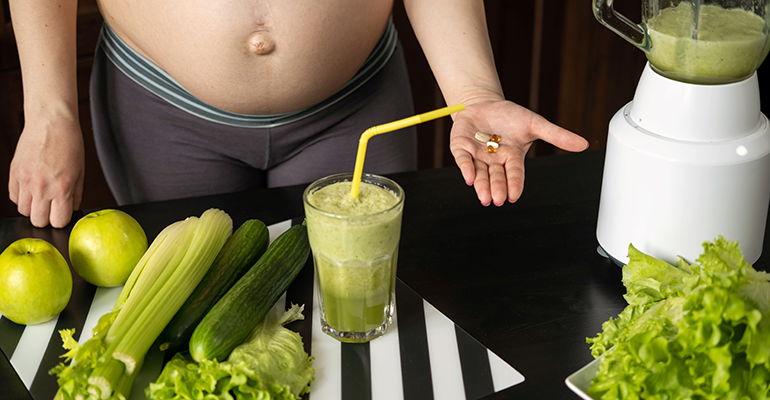
As well as achieving adequate gestational weight gain per the pre-pregnancy BMI categories and adhering to healthy dietary patterns and food safety recommendations, pregnant women also require appropriate and timely nutrient supplementation to meet their nutritional and foetal needs. Supplements that are often required to meet these nutritional needs include iron (27 to 45 mg), omega-3 (at least 200 mg), folic acid (up to 40 mg), vitamin D, and calcium.
To fulfil this demand, an increasing number of brands including traditional established players and new dynamic startups are innovating in the maternal supplement space.
 © AdobeStock/Светлана Волынкина
“The industry is moving towards a staged approach,” said Munari. “[A lot of] women focused small players that generally have female founders and are talking to other women and telling them a story are booming now.”
The consumerisation of the category over recent years has also transformed the delivery formats of supplements from traditional pills to more diverse formats such as cereal bars and gummies. Products that score high on purchase intent and credibility, as well as ease of adoption are performing best, according to research conducted recently by Nestlé which indicated signs of pill and tablet fatigue, Munari explained.

Get more of our news on Google
Set Ingredients Network as a 'Preferred Source' to get quicker access to the news you value.
Related news

The rise of CPG disruptor brands
9 Apr 2026
Bold, relevant, and agile disruptor brands, such as Olly and Poppi are reshaping consumer packaged goods (CPG) and driving growth in stagnant areas – reframing everything about the categories they are showing up in, say experts.
Read more
Vitafoods Middle East and Africa to launch in Dubai in 2026
9 Jan 2026
The Vitafoods portfolio of nutraceutical events is expanding, with Vitafoods Middle East and Africa launching in September 2026 in Dubai, United Arab Emirates.
Read more
Calorie decline and claims fatigue: Euromonitor’s 2026 forecast
6 Jan 2026
Major economic shifts and growing consumer uptake of GLP-1s and AI are shaping how – and what – people eat, according to a Euromonitor market analysis.
Read more
Has ‘clean’ had its day?
22 Dec 2025
Wielding clean-label positioning and fortification as marketing levers is a dangerous strategy, and brands would be better off explaining the hows and whys of the ingredients in their products, say experts.
Read more
Celebrating the winners of the Fi Europe Innovation Awards 2025
3 Dec 2025
Food industry stakeholders celebrated as the winners of the Fi Europe Innovation Awards were announced at a ceremony in Paris.
Read more
Alternative protein startups pivot to B2B ingredients amid funding shift
27 Nov 2025
Alt protein startups are pivoting from consumer meat analogues to high-value B2B ingredients, driven by stronger investor interest, better margins, and clearer commercial pathways.
Read more
Walmart Marketplace’s record growth prompts search for UK sellers
26 Sep 2025
Walmart’s third-party e-commerce platform, Marketplace, has witnessed extraordinary growth – but a need for more product diversity has prompted the retailer to recruit UK sellers.
Read more
The winners of Vitafoods Europe Startup Challenge 2025 revealed
29 May 2025
Four startups – Yomio Drops, PFx Biotech, Revobiom, and Favamole – took top prizes at this year’s Vitafoods Europe Startup Challenge awards.
Read more
East takes on West in the fight for future food flavours
30 Apr 2025
Asian and South American flavours are now key components on global menus, driven by a growing global appetite for culinary mashups.
Read more
Food companies urged to bring ‘joy’ and urgency to healthy food mission
14 Mar 2025
For too long, businesses have treated health and sustainability as separate agendas – but there is growing evidence to show diets that benefit human health can also enhance that of the planet, say experts.
Read more