
Ingredients Categories
Finished Products
Finished Food Categories
- Bakery
- Beverages / Juices
- Cereal and grain products
- Confectionery
- Cooking Fats & Oils
- Dairy
- Egg products
- Fruits & Vegetables
- Infant & Baby food
- Meat, Poultry & Fish
- Nuts & Seeds products
- Other Finished Food Categories
- Pet Food
- Plant-based foods
- Prepared foods
- Sauces & Seasonings
- Sweet & Savoury Spreads
Specialised Finished Products
- Bee products
- Biotic products
- Dietary supplements
- Energy drinks
- Functional beverages
- Functional confectionery
- Functional food
- Functional powders
- Meal replacement products
- Nutricosmetics
- Other Specialised Finished Products
- Pet Dietary Supplements
- Pharma and OTC products
- Protein products
- Sugar replacers / Sweeteners
Health & Wellness Areas
Delivery Formats
Operations & Services
- 3D printing
- Analysis/ Testing
- Auditing & certifications
- Blending & mixing
- Bottling
- Certification
- Clinical trials
- Co-packing
- Coating
- Consulting
- Contract manufacturing
- Drying
- Electrospinning
- Encapsulating
- Enzymatic processing
- Extracting
- Extrusion
- Fat structuring
- Fermentation
- Filling
- Flavour development
- Freeze drying
- Granulating/ grinding/ milling / mixing
- High-pressure processing
- Labelling
- Other Operations & Services
- Packaging
- Packet filling
- Pasturising
- Quality assurance
- Saccharification
- Shear cell processing
- Spray drying
- Sterilisation
- Storage & Logistics
- Tabletting
- Toasting / roasting
- Ultra-high temperature processing
News
Clean-label cereals prompt fortification debate
David Burrows, Freelance Journalist 28 Mar 2025Marks & Spencer has caused a stir with the launch of a range of breakfast cereals in the UK containing minimal ingredients.
The star of the line-up is cornflakes, made with corn and nothing else. The newly designed box simply reads: “Corn Flakes. Only 1 Ingredient. Corn 325 g.”
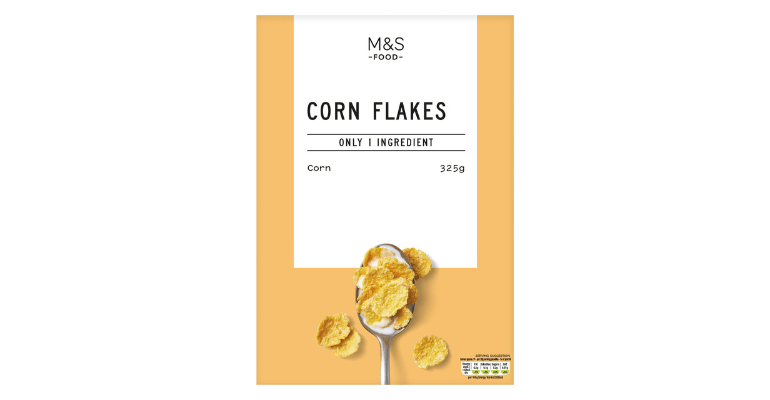
The upmarket food retailer’s Multigrain Hoops product contains five ingredients – again, listed in large font on the front of the packaging: oat flour (115 g), corn flour (109 g), brown rice flour (56 g), date syrup (19 g), salt (1 g).
Also in the range is a Choco Hoops product, which contains six ingredients – the five in the Multigrain Hoops plus cocoa powder. The cereal boxes also carry information regarding their nutritional content in the bottom right-hand corner.
“M&S has always led the way on having the cleanest food – and with this new range, the team has pushed the boundaries again,” said Alex Freudmann, managing director at M&S Food.
The standard cornflakes made by the retailer are fortified, with an ingredients list that includes maize, sugar, salt, barley, malt extract, iron, niacin, pantothenic acid, vitamin B6, riboflavin, thiamine, folic acid, vitamin D, and vitamin B12.
The one-ingredient product is more than four times the price of the standard.
The move has prompted a debate about fortification of foods and ultra-processing. Clean-label foods will be a “huge trend” in 2025 and onwards, explained one clinical nutritionist on social media, who asked: “While the idea of simpler, less processed foods is appealing, is removing essential vitamins and minerals the right move?”
Strong support for fortification
Fortification has certainly played a key role in public health for many years.
In the UK, many families – particularly those on lower incomes – rely on fortified cereals for key nutrients that can be difficult to obtain from diet alone. Fortified breakfast cereals are a significant source of iron in British diets, for example.
Ali Morpeth, co-founder of the Planeatry Alliance and a registered nutritionist, called for more communication and “influencing” around the positive role of added ingredients via fortification – which would ensure that demand for “better-for-you” and clean-label products does not create market dynamics where products become less nutritionally adequate.
“Food fortification is a tool to help people meet nutritional needs,” she added.
A secondary analysis of the UK National Diet and Nutrition Survey, published in 2022, showed that among people consuming a diet without fortified foods, 21 to 45% and 5 to 29% had respectively mineral and vitamin intakes below requirements.
Among those consuming a diet with voluntarily fortified foods, prevalence of nutrient inadequacies decreased by between 3 and 13%.
“Voluntary fortified foods but not supplements made a meaningful contribution to intakes of vitamin and minerals, without risk of unacceptably high intakes,” the authors wrote in the Journal of Nutritional Science.
Fortification and ultra-processing
Fortification of plant milks is also being debated as scrutiny of processed and ultra-processed foods increases. One in three UK consumers drinks plant-based milks, which are often – but not always – fortified with calcium, vitamin D, and iodine; however, there is no standard formulation.
Concerns have been raised by the food industry that the debate over ultra-processed foods is overly simplistic. Indeed, at the International Food and Drink event recently there were reportedly questions about whether fortification equals ultra-processing.
The nuance over the nutritional qualities of foods is at risk of being lost. As one nutritionist put it: “A clean-label option is great, but maintaining fortified alternatives ensures accessibility for those who need them.”
Around one in six adults in the UK has low levels of vitamin D, a deficiency of which can lead to rickets, bone pain, and disabilities. Many cereals are also fortified with iron and other vitamins.
New legislation introduced in the UK in November 2024 will require millers and flour producers to fortify non-wholemeal wheat flour with folic acid from the end of 2026.

Get more of our news on Google
Set Ingredients Network as a 'Preferred Source' to get quicker access to the news you value.
Related news

Do the US dietary guidelines put UPFs under pressure?
10 Sep 2026
Will the US dietary guidelines change the way Americans eat, swapping ultra-processed foods for whole foods? We asked Dr Barry Popkin, renowned nutrition and obesity researcher.
Read more
Food fraud costs UK economy £2bn each year
9 Sep 2026
Food fraud is costing the UK economy up to £2 billion (€2.3 billion) every year although the food sector is more “resilient” than others, according to a recent study.
Read more
Kellogg accelerates work to remove artificial colours from all US cereals
3 Sep 2026
WK Kellogg has announced an accelerated timeline to eliminate all artificial colours and the chemical preservative, BHT, across its full US portfolio of cereals and cereal packaging.
Read more
Skimpflation: An ‘unfair’ and risky approach to keeping prices low
2 Sep 2026
Consumers see skimpflation – reducing the quality of ingredients due to rising costs – as more unfair than shrinkflation, making it a risky strategy according to recent research.
Read more
NielsenIQ’s EU barometer shows Britain leading in grocery inflation
31 Aug 2026
Britain was the only country to record grocery inflation above 2%, according to NielsenIQ data that compared Europe’s five biggest grocery markets from February to May 2026.
Read more
‘Urgent gaps’ in achieving 2030 food system goals
27 Aug 2026
Global food systems are failing to meet 2030 targets across indicators including health, environment, and resilience, according to a report co-authored by the Food and Agriculture Organisation (FAO).
Read more
Chimac’s fusion sauces bring Korean flavours to Europe
25 Aug 2026
Irish sauce brand Chimac is tapping into Korea’s culinary traditions, bringing its flavours and products to European consumers who want a taste of K-food.
Read more
Global demand for instant noodles continues to rise
24 Aug 2026
Global demand for instant noodles reached 124.21 billion servings last year, representing a 0.7% year-on-year increase – or 900 million extra servings.
Read more
Popular barbecue staples experience sharp price increases
19 Aug 2026
The typical cost of US shoppers’ barbecue baskets has risen by 12% over the past year – the fastest annual rise in a decade, figures from The Economist show.
Read more
Hot NPD: Nissin launches first cold-water Cup Noodles
18 Aug 2026
Nissin is taking one of Japan’s most iconic instant meals in a completely new direction with the launch of the first cold water-only Cup Noodles in the brand’s 55-year history.
Read more