
Ingredients Categories
Finished Products
Finished Food Categories
- Bakery
- Beverages / Juices
- Cereal and grain products
- Confectionery
- Cooking Fats & Oils
- Dairy
- Egg products
- Fruits & Vegetables
- Infant & Baby food
- Meat, Poultry & Fish
- Nuts & Seeds products
- Other Finished Food Categories
- Pet Food
- Plant-based foods
- Prepared foods
- Sauces & Seasonings
- Sweet & Savoury Spreads
Specialised Finished Products
- Bee products
- Biotic products
- Dietary supplements
- Energy drinks
- Functional beverages
- Functional confectionery
- Functional food
- Functional powders
- Meal replacement products
- Nutricosmetics
- Other Specialised Finished Products
- Pet Dietary Supplements
- Pharma and OTC products
- Protein products
- Sugar replacers / Sweeteners
Health & Wellness Areas
Delivery Formats
Operations & Services
- 3D printing
- Analysis/ Testing
- Auditing & certifications
- Blending & mixing
- Bottling
- Certification
- Clinical trials
- Co-packing
- Coating
- Consulting
- Contract manufacturing
- Drying
- Electrospinning
- Encapsulating
- Enzymatic processing
- Extracting
- Extrusion
- Fat structuring
- Fermentation
- Filling
- Flavour development
- Freeze drying
- Granulating/ grinding/ milling / mixing
- High-pressure processing
- Labelling
- Other Operations & Services
- Packaging
- Packet filling
- Pasturising
- Quality assurance
- Saccharification
- Shear cell processing
- Spray drying
- Sterilisation
- Storage & Logistics
- Tabletting
- Toasting / roasting
- Ultra-high temperature processing
News
Iceland’s chicken drumstick ice cream: Do novelty products really work?
Kacey Culliney, Freelance Journalist 30 Jun 2026Iceland Foods has launched an ice cream that looks like a chicken drumstick. Fun innovation or food flop? We asked two brand experts for their verdict.
British supermarket Iceland Foods recently launched a single-serve ice cream product designed to look like a chicken drumstick.
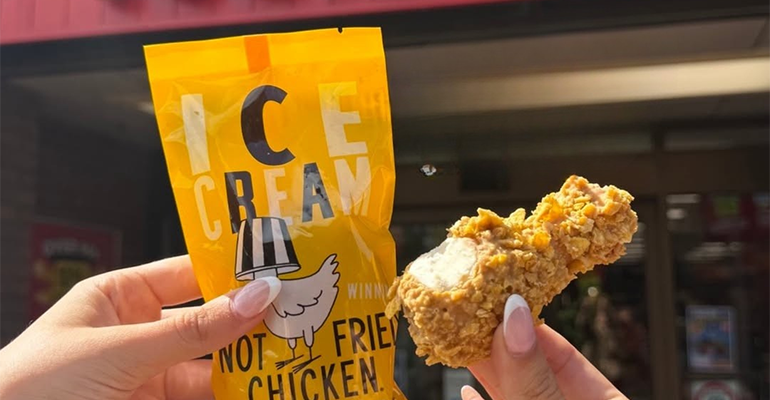
Falling into the renowned pastry discipline “trompe-l'oeil”, where cake products are designed to look exactly like something else, the supermarket chain's Not Fried Chicken ice cream features waffle cone ice cream, a cornflake coating, and a chocolate-covered pretzel in the centre designed to resemble a chicken bone.
Retailing for £4, the ice cream is garnering a lot of attention across social media platforms in the UK, notably TikTok. But can a product like this really go the distance? Will it secure repeat purchases or be viewed as a one-off gimmick?
Cake or fake? Ice cream chicken is ‘a dream for social media’
“What Iceland has done here is remind the entire industry of something we sometimes forget: that food is allowed to be joyful,” said Vhari Russell, marketing expert and founder of The Food Marketing Experts. “In a landscape dominated by conversations about health, sustainability, cost of living and reformulation, a chicken drumstick that's actually ice cream is a breath of fresh air.”
Helga Hertsig-Lavocah, futurologist and founder of trend forecasting agency Hint Futurology, agreed: “It's all part of small treats and escapism, which we desperately need in a world that for many feels out of control.”
Hertsig-Lavocah said this is a low-risk innovation for Iceland Foods, given the product holds “intergenerational” appeal and is “cheaper than a fancy viral iced coffee”.
“This ticks all the boxes: it's a dream for social media, puts new eyeballs on Iceland, and it's a low investment/risk for the brand and consumer,” she said. The product also taps into the “cake or fake” movement that many consumers are already familiar with and that brands worldwide have long been invested in, particularly in Japan, she said.
‘There will always be value in hype’
Importantly, Hertsig-Lavocah said this launch creates attention and earned media value (EMV) for Iceland Foods. “It keeps Iceland top of mind, so there will always be value in hype.”
Russell agreed the launch certainly draws attention to Iceland Foods; important given the retailer competes in a crowded, price-sensitive market where “cut-through is everything”.
“I think it's genuinely brilliant marketing from Iceland. A product that looks exactly like a chicken drumstick but is actually ice cream? That's the kind of idea that stops you mid-scroll, makes you laugh, and crucially makes you want to share it immediately. Which is exactly what happened. The fact that it went viral on TikTok tells you everything you need to know about whether it worked.”
Iceland Foods also likely wanted to draw in a younger audience and reposition as a “fun, culturally relevant brand”, she said.
The 'halo effect' of viral food launches
Russell said smart food innovations from UK retailers is certainly a space to watch.
“Iceland and M&S [Marks & Spencer] are quietly becoming the two most exciting retailers in the UK when it comes to creating products that grab attention and drive genuine footfall,” she said. M&S has been invested in viral food launches for years, from its light-up gin bottle, Colin the Caterpillar cake and various Percy Pig extensions – and Iceland Foods is now “increasingly playing the same game with real confidence”.
Both understand something that many retailers are still catching up with, the expert said. “A single viral product doesn't just sell itself; it brings people through the door who then fill their basket with everything else. The halo effect on the wider shop is enormous.”
Iceland Foods and M&S, she said, are “leading the way in demonstrating that fun is a genuine commercial strategy, not a shortcut”.
‘This is what bold, confident, consumer-first NPD looks like’
Whilst a chicken drumstick ice cream launch is fun, Russell said there is a “much more commercially sophisticated strategy at work here too”.
Average basket spend increases significantly when a novelty product pulls new or lapsed customers through the door, she said, because customers browse, discover, and buy.
“Iceland knows this. M&S knows this. It's one of the most powerful and underappreciated levers in retail, using a single headline product to monetise the entire visit,” she said.
“...Iceland and M&S are showing the rest of the industry what bold, confident, consumer-first product development looks like in 2026. They are proving that novelty, when it's done with genuine creativity and commercial intelligence, is not a gimmick; it's a growth strategy.
“It drives footfall, it builds baskets, it creates brand advocates and it makes people feel something at a time when most of us are largely numb to conventional advertising. More of this, please. The industry needs it,” Russell said.

Get more of our news on Google
Set Ingredients Network as a 'Preferred Source' to get quicker access to the news you value.
Related news

Do the US dietary guidelines put UPFs under pressure?
10 Sep 2026
Will the US dietary guidelines change the way Americans eat, swapping ultra-processed foods for whole foods? We asked Dr Barry Popkin, renowned nutrition and obesity researcher.
Read more
Food fraud costs UK economy £2bn each year
9 Sep 2026
Food fraud is costing the UK economy up to £2 billion (€2.3 billion) every year although the food sector is more “resilient” than others, according to a recent study.
Read more
Kellogg accelerates work to remove artificial colours from all US cereals
3 Sep 2026
WK Kellogg has announced an accelerated timeline to eliminate all artificial colours and the chemical preservative, BHT, across its full US portfolio of cereals and cereal packaging.
Read more
Skimpflation: An ‘unfair’ and risky approach to keeping prices low
2 Sep 2026
Consumers see skimpflation – reducing the quality of ingredients due to rising costs – as more unfair than shrinkflation, making it a risky strategy according to recent research.
Read more
NielsenIQ’s EU barometer shows Britain leading in grocery inflation
31 Aug 2026
Britain was the only country to record grocery inflation above 2%, according to NielsenIQ data that compared Europe’s five biggest grocery markets from February to May 2026.
Read more
‘Urgent gaps’ in achieving 2030 food system goals
27 Aug 2026
Global food systems are failing to meet 2030 targets across indicators including health, environment, and resilience, according to a report co-authored by the Food and Agriculture Organisation (FAO).
Read more
Chimac’s fusion sauces bring Korean flavours to Europe
25 Aug 2026
Irish sauce brand Chimac is tapping into Korea’s culinary traditions, bringing its flavours and products to European consumers who want a taste of K-food.
Read more
Global demand for instant noodles continues to rise
24 Aug 2026
Global demand for instant noodles reached 124.21 billion servings last year, representing a 0.7% year-on-year increase – or 900 million extra servings.
Read more
Popular barbecue staples experience sharp price increases
19 Aug 2026
The typical cost of US shoppers’ barbecue baskets has risen by 12% over the past year – the fastest annual rise in a decade, figures from The Economist show.
Read more
Hot NPD: Nissin launches first cold-water Cup Noodles
18 Aug 2026
Nissin is taking one of Japan’s most iconic instant meals in a completely new direction with the launch of the first cold water-only Cup Noodles in the brand’s 55-year history.
Read more