
Ingredients Categories
Finished Products
Finished Food Categories
- Bakery
- Beverages / Juices
- Cereal and grain products
- Confectionery
- Cooking Fats & Oils
- Dairy
- Egg products
- Fruits & Vegetables
- Infant & Baby food
- Meat, Poultry & Fish
- Nuts & Seeds products
- Other Finished Food Categories
- Pet Food
- Plant-based foods
- Prepared foods
- Sauces & Seasonings
- Sweet & Savoury Spreads
Specialised Finished Products
- Bee products
- Biotic products
- Dietary supplements
- Energy drinks
- Functional beverages
- Functional confectionery
- Functional food
- Functional powders
- Meal replacement products
- Nutricosmetics
- Other Specialised Finished Products
- Pet Dietary Supplements
- Pharma and OTC products
- Protein products
- Sugar replacers / Sweeteners
Health & Wellness Areas
Delivery Formats
Operations & Services
- 3D printing
- Analysis/ Testing
- Auditing & certifications
- Blending & mixing
- Bottling
- Certification
- Clinical trials
- Co-packing
- Coating
- Consulting
- Contract manufacturing
- Drying
- Electrospinning
- Encapsulating
- Enzymatic processing
- Extracting
- Extrusion
- Fat structuring
- Fermentation
- Filling
- Flavour development
- Freeze drying
- Granulating/ grinding/ milling / mixing
- High-pressure processing
- Labelling
- Other Operations & Services
- Packaging
- Packet filling
- Pasturising
- Quality assurance
- Saccharification
- Shear cell processing
- Spray drying
- Sterilisation
- Storage & Logistics
- Tabletting
- Toasting / roasting
- Ultra-high temperature processing
News
Balenti adds the benefits of baobab to functional nut butters
Niamh Michail, Head of Publishing 19 Apr 2024French startup Balenti uses sustainably sourced, wild-harvested baobab fruit to make its healthy nut butters with functional benefits.
Paris-based startup Balenti was founded by Binta Lopes Rodrigues, who saw the business as a way of bringing the benefits of baobab to a wider market. By adding the ingredient to finished products, she can contribute to empowering women to sustainably harvest baobab; protecting wild baobab trees; and bringing the health benefits to consumers in Europe.
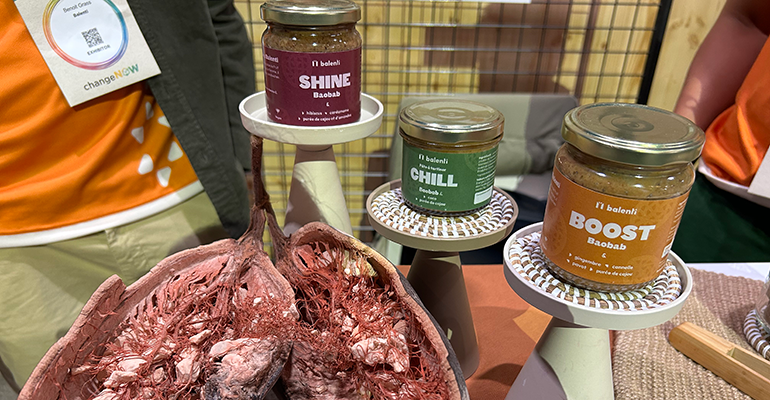
“I'm from Guinea Bissau, I grew up there and spent 15 years of my life there eating baobab ice cream and juice. It was something that I always had in my routine but years later I discovered all the scientific studies about the richness of this ingredient – it’s a superfood and a powerhouse with vitamins, fibre, and prebiotic fibre. It also gives lots of energy and it’s delicious,” she said, speaking to Ingredients Network at the ChangeNOW Summit in Paris last month.
“Then I started asking myself why it is not more known […] – especially after I discovered it's a wild ingredient so it's a source of revenue for local communities in West Africa and it's also a way to preserve and protect the forest.”
Three baobab-spiked nut butters to shine, energise, and de-stress
Balenti has three baobab-infused nut butters whose branding centres on the health benefits they aim to deliver: De-Stress, Shine, and Boost.
The De-Stress nut butter contains cashew paste, dates, coconut, baobab powder, agave syrup, coconut and sunflower oil, oat fibre, and lemon zest. The Shine nut butter has an almond and cashew base and contains baobab, hibiscus, cranberry, and cardamom while the Boost spread contains poppy seeds, cinnamon, and ginger.
Adding baobab powder to a nut butter was a way to use this relatively unknown ingredient in a familiar format, she said.
“We figured out that customers want something easy to use because baobab is already a new fruit for them: they don't know how to use it, where to put it, and they mix it with things that are not good. And then they say, ‘Oh, it's super good for the health but it's not tasty.’
“But it is tasty – you just need to know what to mix it with! So that's why we [decided] we needed to create finished goods to make it easier for people to use it in a product that appeals to them.”
Baobab launches have a health and wellness positioning
Indigenous to Africa, baobab trees can tolerate high temperatures and long periods of drought. Wild harvested, the fruit pulp has a sharp, fruity flavour – Balenti describes it as a cross between a lemon and a peach – and the seeds can be pressed for oil.
Baobab powder is a rich source of vitamin C – one 10 g serving provides one third of the recommended daily requirement – and fibre as it is made up of almost 50% fibre. The pulp also contains calcium, potassium, phosphorous, and other nutrients.
Although relatively unknown in Europe, product launches with baobab have been rising slowly but steadily over the past decade, with most launches leveraging a health and wellness positioning, according to data from Mintel’s Global New Product Database (GNPD).
Innocent Drinks, for instance, recently launched a Revitalise Super Smoothie in Belgium made with apple, cranberry, raspberry, pomegranate, flax seeds, and baobab puree.
UK brand Naturya launched an Apple & Cinnamon SuperShake powder with baobab while in Poland Rossmann enerBiO launched an antioxidant fruit bar made with 2% baobab fruit powder. In the UK, Marks & Spencer partnered with personalised nutrition startup Zoe for the co-branded M&S Food X ZOE Gut Shot that contains baobab fruit pulp.
Adding value to African superfoods
Balenti worked with an R&D company to perfect the products’ formulation in terms of the nutritional profile and taste. But the decision to use cashew paste as the main nut base also stemmed from a desire to use ingredients that are produced locally in Guinea Bissau and West Africa. Cashew paste offers other advantages because the final product does not need to be pasteurised, which helps retain the nutrients of all the ingredients, said Lopes Rodrigues.
“The spreads are a way to add value to the baobab ingredient,” she said. “We work with female cooperatives, and they are the ones telling us what's their price and we respect their price.”
Balenti also supplies baobab powder to brands that want to create co-branded products. So far, it has worked with artisanal manufacturers and restaurants making baobab juice, ice cream, and sweet snacks.
“We're looking forward to partnering with brands that want to embrace this baobab journey with us, not only for the health benefits but also for the impact that it's delivering for the local community,” said the entrepreneur.
It is also an easy ingredient to produce and work with, she added.
“It's a wonderful fruit because it's so rich and it's naturally dry, so it's very easy to store,” she said. “You don't need to use water in the [processing] and the cooperatives work with solar energy.”
Balenti currently sells on its website and in some brick-and-mortar stores in France, and it is currently in negotiations with wholesalers. Ultimately, the company wants to manufacture its products in France for the European market and in Guinea Bissau for the African market.

Get more of our news on Google
Set Ingredients Network as a 'Preferred Source' to get quicker access to the news you value.
Related news

Do the US dietary guidelines put UPFs under pressure?
10 Sep 2026
Will the US dietary guidelines change the way Americans eat, swapping ultra-processed foods for whole foods? We asked Dr Barry Popkin, renowned nutrition and obesity researcher.
Read more
Health and wellness engagement matures across Middle East and Africa
4 Sep 2026
Many consumers in the Middle East and Africa are now proactively engaged in health and wellness, looking to integrate better habits and products into their daily lives, say experts.
Read more
Skimpflation: An ‘unfair’ and risky approach to keeping prices low
2 Sep 2026
Consumers see skimpflation – reducing the quality of ingredients due to rising costs – as more unfair than shrinkflation, making it a risky strategy according to recent research.
Read more
‘Urgent gaps’ in achieving 2030 food system goals
27 Aug 2026
Global food systems are failing to meet 2030 targets across indicators including health, environment, and resilience, according to a report co-authored by the Food and Agriculture Organisation (FAO).
Read more
Seven-Eleven uses microbial testing tech to extend katsudon shelf life
26 Aug 2026
Japanese retail company Seven-Eleven has improved its factory’s microbial environment to keep comfort-food staple, katsudon, fresher for longer.
Read more
Chimac’s fusion sauces bring Korean flavours to Europe
25 Aug 2026
Irish sauce brand Chimac is tapping into Korea’s culinary traditions, bringing its flavours and products to European consumers who want a taste of K-food.
Read more
Global demand for instant noodles continues to rise
24 Aug 2026
Global demand for instant noodles reached 124.21 billion servings last year, representing a 0.7% year-on-year increase – or 900 million extra servings.
Read more
Popular barbecue staples experience sharp price increases
19 Aug 2026
The typical cost of US shoppers’ barbecue baskets has risen by 12% over the past year – the fastest annual rise in a decade, figures from The Economist show.
Read more
Hot NPD: Nissin launches first cold-water Cup Noodles
18 Aug 2026
Nissin is taking one of Japan’s most iconic instant meals in a completely new direction with the launch of the first cold water-only Cup Noodles in the brand’s 55-year history.
Read more
Manam Chocolate aims to bring premium Indian cacao to 'the world stage'
11 Aug 2026
Craft chocolate brand Manam Chocolate is investing in local expansion and supply chain innovation throughout India as it works to build out the premium reputation of its locally produced cacao products.
Read more