
Ingredients Categories
Finished Products
Finished Food Categories
- Bakery
- Beverages / Juices
- Cereal and grain products
- Confectionery
- Cooking Fats & Oils
- Dairy
- Egg products
- Fruits & Vegetables
- Infant & Baby food
- Meat, Poultry & Fish
- Nuts & Seeds products
- Other Finished Food Categories
- Pet Food
- Plant-based foods
- Prepared foods
- Sauces & Seasonings
- Sweet & Savoury Spreads
Specialised Finished Products
- Bee products
- Biotic products
- Dietary supplements
- Energy drinks
- Functional beverages
- Functional confectionery
- Functional food
- Functional powders
- Meal replacement products
- Nutricosmetics
- Other Specialised Finished Products
- Pet Dietary Supplements
- Pharma and OTC products
- Protein products
- Sugar replacers / Sweeteners
Health & Wellness Areas
Delivery Formats
Operations & Services
- 3D printing
- Analysis/ Testing
- Auditing & certifications
- Blending & mixing
- Bottling
- Certification
- Clinical trials
- Co-packing
- Coating
- Consulting
- Contract manufacturing
- Drying
- Electrospinning
- Encapsulating
- Enzymatic processing
- Extracting
- Extrusion
- Fat structuring
- Fermentation
- Filling
- Flavour development
- Freeze drying
- Granulating/ grinding/ milling / mixing
- High-pressure processing
- Labelling
- Other Operations & Services
- Packaging
- Packet filling
- Pasturising
- Quality assurance
- Saccharification
- Shear cell processing
- Spray drying
- Sterilisation
- Storage & Logistics
- Tabletting
- Toasting / roasting
- Ultra-high temperature processing
News
Will Trump lower tariff hikes?
Natasha Spencer-Jolliffe, Freelance Journalist 25 Apr 2025The US President’s plan to reduce the 145% tariffs on China’s food and beverage market raises questions over whether a turnaround is likely for other regions.
Hailed as “Liberation Day”, on 2 April, the Trump administration brought in a range of tariff hikes, including a global baseline of 10%. Starting from 5 April, barriers emerged after the US government reported that the country’s trade deficit in goods exceeded $1.2 trillion (€1.1 trn) in 2024.
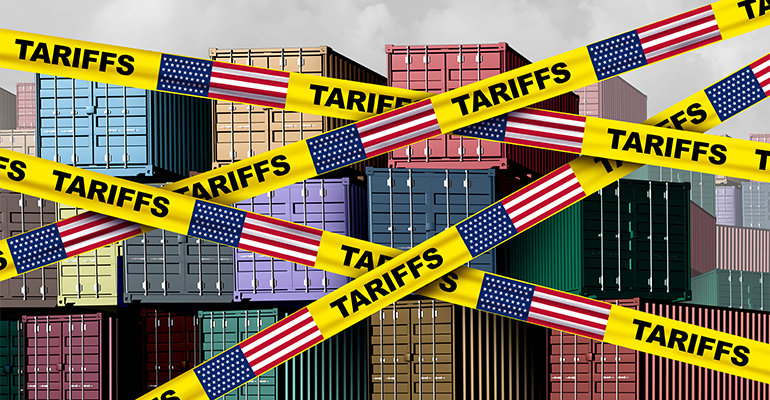
Higher tariffs, above the baseline, apply to certain countries and came into effect from 9 April, including 20% on food and beverages (F&B) in the European Union (EU), 49% in Cambodia, 47% in Madagascar, and 44% in Sri Lanka, among others.
Additionally, a 154% tariff was imposed on products from China, a country whose exports to the US totalled approximately $450 billion (€395 bn) in 2023.
However, as reported later that month, Trump said he planned to lower China’s tariff, stating: “145% is too high. It will come down substantially.”
The new trade normal
Major F&B exports to the US from around the globe are now experiencing the reality of higher costs to trade with the North American market, which in 2024 achieved annual retail sales of $1,000.6 billion.
Manufacturers from across the industry, including in the cheese, chocolate, fruit and vegetables, olive oil, wine, beer, and spirits sectors, are now subject to the increased tariffs.
Announcing the new measures, Trump said that foreign trade and economic practices had created a national emergency. The White House said it was reclaiming its economic sovereignty in its official fact sheet. Underpinning this stance is the belief that tariffs are necessary to achieve fair trade and lower the US trade deficit.
According to the Budget Lab at Yale University, the US tariff increases to date in 2025 have resulted in raising $3.1 trn, which includes the impact of retaliations.
F&B industry calls for a rethink
Voices from across the sector criticised the US government’s decision to impose higher tariff rates on countries worldwide.
“Europe’s food and drink industry deeply regrets the US’ decision to impose 20% tariffs on imports from the EU, given the impact it will have on transatlantic trade, businesses and consumers,” industry association Food Drink Europe said.
The organisation added that it was reiterating its call to de-escalate trade tensions and is backing the EU’s plan to reach a negotiation.
In a press release, the European Dairy Association (EDA) condemned the sweeping tariffs on EU goods, saying the impact on the dairy industry was unjustified. It called on the European Commission to respond strategically and protect the EU industry from further detrimental impacts.
“Trade policy must be smart, not punitive. Dairy is not the problem here, using it as a pawn only creates new problems on both sides of the Atlantic,” said Alexander Anton, secretary general of EDA.
European body CELCAA, which supports traders in agri-food commodities, published its “disappointed and saddened” response to the tariffs.
“It is a sorry day for trade and, ultimately, for the consumer in the US,” it said.
According to leading European bank ING, EU manufacturers and exporters across the food and agricultural value chain have expected this increase, following rising US inventories.
“The uncertainty about the duration of these tariffs makes it more complex to determine what the next response will be at the company level,” said Thijs Geijer, senior sector economist covering the food and agriculture sector at ING.
Strategies for surviving the tariff increases
In the short term, ING said that F&B manufacturers have several options in response to the US tariff increases.
Price is one area where producers can focus on adjusting or negotiating costs to reach a new optimum level that balances their product volumes and margins.
However, this would result in manufacturers making the tough choice between absorbing these prices or passing them on to price-sensitive consumers already navigating ongoing cost-of-living concerns.
As the tariff hikes originate in the US, ING also suggested producers maximise output in US processing facilities to utilise their production plants, units, operations, and resources to support their manufacturing and innovation. Investing in additional US production capacity is another beneficial strategy to help manufacturers navigate tariff increases.
ING also stated that F&B manufacturers could consider engaging in more value-adding activities, such as packing and bottling goods in the US, to lower the dutiable value of imports.
Finally, it recommended adopting an outward-looking approach beyond the US to bolster brands’ capabilities.
Reconfiguring supply chains to optimise how products flow between countries, growing sales in the EU market at the expense of imported goods, and increasing sales in alternative markets outside the EU, such as Mexico and Southeast Asia, are also options that manufacturers can explore in the coming months.

Get more of our news on Google
Set Ingredients Network as a 'Preferred Source' to get quicker access to the news you value.
Related news

Do the US dietary guidelines put UPFs under pressure?
10 Sep 2026
Will the US dietary guidelines change the way Americans eat, swapping ultra-processed foods for whole foods? We asked Dr Barry Popkin, renowned nutrition and obesity researcher.
Read more
Health and wellness engagement matures across Middle East and Africa
4 Sep 2026
Many consumers in the Middle East and Africa are now proactively engaged in health and wellness, looking to integrate better habits and products into their daily lives, say experts.
Read more
Skimpflation: An ‘unfair’ and risky approach to keeping prices low
2 Sep 2026
Consumers see skimpflation – reducing the quality of ingredients due to rising costs – as more unfair than shrinkflation, making it a risky strategy according to recent research.
Read more
‘Urgent gaps’ in achieving 2030 food system goals
27 Aug 2026
Global food systems are failing to meet 2030 targets across indicators including health, environment, and resilience, according to a report co-authored by the Food and Agriculture Organisation (FAO).
Read more
Seven-Eleven uses microbial testing tech to extend katsudon shelf life
26 Aug 2026
Japanese retail company Seven-Eleven has improved its factory’s microbial environment to keep comfort-food staple, katsudon, fresher for longer.
Read more
Chimac’s fusion sauces bring Korean flavours to Europe
25 Aug 2026
Irish sauce brand Chimac is tapping into Korea’s culinary traditions, bringing its flavours and products to European consumers who want a taste of K-food.
Read more
Global demand for instant noodles continues to rise
24 Aug 2026
Global demand for instant noodles reached 124.21 billion servings last year, representing a 0.7% year-on-year increase – or 900 million extra servings.
Read more
Popular barbecue staples experience sharp price increases
19 Aug 2026
The typical cost of US shoppers’ barbecue baskets has risen by 12% over the past year – the fastest annual rise in a decade, figures from The Economist show.
Read more
Hot NPD: Nissin launches first cold-water Cup Noodles
18 Aug 2026
Nissin is taking one of Japan’s most iconic instant meals in a completely new direction with the launch of the first cold water-only Cup Noodles in the brand’s 55-year history.
Read more
Manam Chocolate aims to bring premium Indian cacao to 'the world stage'
11 Aug 2026
Craft chocolate brand Manam Chocolate is investing in local expansion and supply chain innovation throughout India as it works to build out the premium reputation of its locally produced cacao products.
Read more