
Ingredients Categories
Finished Products
Finished Food Categories
- Bakery
- Beverages / Juices
- Cereal and grain products
- Confectionery
- Cooking Fats & Oils
- Dairy
- Egg products
- Fruits & Vegetables
- Infant & Baby food
- Meat, Poultry & Fish
- Nuts & Seeds products
- Other Finished Food Categories
- Pet Food
- Plant-based foods
- Prepared foods
- Sauces & Seasonings
- Sweet & Savoury Spreads
Specialised Finished Products
- Bee products
- Biotic products
- Dietary supplements
- Energy drinks
- Functional beverages
- Functional confectionery
- Functional food
- Functional powders
- Meal replacement products
- Nutricosmetics
- Other Specialised Finished Products
- Pet Dietary Supplements
- Pharma and OTC products
- Protein products
- Sugar replacers / Sweeteners
Health & Wellness Areas
Delivery Formats
Operations & Services
- 3D printing
- Analysis/ Testing
- Auditing & certifications
- Blending & mixing
- Bottling
- Certification
- Clinical trials
- Co-packing
- Coating
- Consulting
- Contract manufacturing
- Drying
- Electrospinning
- Encapsulating
- Enzymatic processing
- Extracting
- Extrusion
- Fat structuring
- Fermentation
- Filling
- Flavour development
- Freeze drying
- Granulating/ grinding/ milling / mixing
- High-pressure processing
- Labelling
- Other Operations & Services
- Packaging
- Packet filling
- Pasturising
- Quality assurance
- Saccharification
- Shear cell processing
- Spray drying
- Sterilisation
- Storage & Logistics
- Tabletting
- Toasting / roasting
- Ultra-high temperature processing
News
How Secon Taste is putting upcycled snacks on shelves
Natasha Spencer-Jolliffe, Freelance Journalist 4 Aug 2026Hungarian zero-waste startup Secon Taste is turning surplus food into upcycled snacks such as fibre-packed granola, instant porridge, and a circular coffee-tasting box.
“Our goal is to make upcycling food the first choice for manufacturers, retailers and consumers,” Júlia Dalmadi, founder and CEO of Secon Taste, told Ingredients Network. It is a vision that first came to life in Hungary in 2021, when founder Dalmadi set out to revolutionise the way people eat through upcycled foods and ingredients.
At a glance:
- Secon Taste upcycles surplus foodstuffs, creating products to fight food waste.
- The startup wanted to show retailers and consumers the value and quality of upcycled foods.
- Through collaboration and education, Secon Taste turns food waste into a retail-friendly offer that promotes sustainability.
The founder saw that while there are numerous upcycling technologies, processes, and ingredients in the food and beverage sector, not all of them actually make it into real products on the shelves. While there is a desire among producers to rescue discarded foods, if they are not available in supermarkets, getting them into shoppers’ meals is a big challenge.
Dalmadi also witnessed the obstacles to implementing circular solutions in the F&B industry. Finding the right supply for ingredients or surplus, and then figuring out how to turn these into desirable products, became key questions from the outset.
Reaching retailers with a unique upcycling offer
Operating out of another manufacturer’s kitchen, Dalmadi began building her zero-waste upcycling startup and asked: “How can I build a stable, consistent supply chain that appeals to retailers?”
Using surplus upcycled ingredients that have been rejected by supermarkets for aesthetic reasons, lacks predictability and forecastability. The quantities of these available ingredients are unknown, making it difficult for manufacturers to plan their formulations and retailers to accept them.
Many byproducts are unfamiliar, so manufacturers may never have heard of these ingredients. “They don’t know how to handle it, how to work with it, how to store it,” said Dalmadi. Even when manufacturers saw the opportunity to invest in new infrastructure to formulate, unless the retailer committed to leasing the final product, it was too risky for them to pursue.
Secon Taste shifted its strategy to ensure retailers saw the value in these upcycled products and had space for them.
“Upcycling is a perfect framework to give them data they can use and report on how they reduce waste in their supply chain, and that's just one aspect of upcycling where impact is measurable,” said Dalmadi.
Preparing for launch
Secon Taste launched its first retail project in the Czech Republic in 2024 and introduced an entire category of upcycled products. It was a milestone moment for the brand. To launch, the brand had to meet a minimum of 15 products. “In fact, we had 45, and we built that category in five months,” said Dalmadi.
Focusing on its first product, Secon Taste turned brewers’ spent grain – the leftover barley from beer production – into high-fibre granola. It was born from the concept that granola was a shelf product, not necessarily targeted to a price-sensitive consumer. The trial worked.
“It was amazing to see that we had a recipe and within six months, we had a co-packer and a packaged product we could sell,” said Dalmadi.
The brand quickly learned that consumers will not buy a product simply because it is upcycled. Instead, they want products that satisfy their taste, nutritional and product preferences. A product must therefore meet those requirements and then upcycled is an added value.
Expansion into food categories, countries and circular solutions
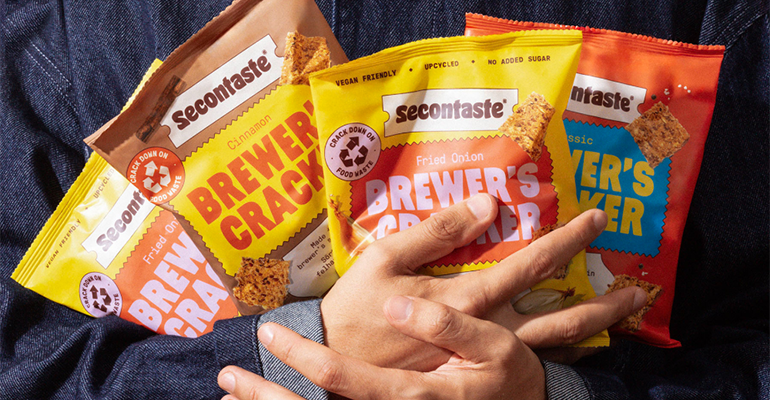
Secon Taste landed on crackers for its second product, after its consumer research found shoppers want conscious snacks and breweries could easily pair them with their beers.
During the research phase, Secon Taste involved consumers in selecting its cracker flavours, giving them samples and gathering their feedback. Initially, the startup planned to launch two products with distinct flavours, but ended up developing five: salt and pepper, fried onion, garlic, thyme, and cinnamon.
Further expansion took place in 2025, with Secon Taste launching in Germany, Austria, Hungary and Romania. It also engaged in collaborative product development to address the surplus of “ugly mushrooms” on the market. It also partnered with a vegan spread manufacturer, launched an instant porridge line and developed a circular coffee-tasting box, designed to uncover the hidden values of the coffee supply chain.
Next year, the brand aims to onboard new retailers, eyeing up a potential move into brick-and-mortar stores. It plans to push forward with its prototype and fundraising phases, focusing on optimising its processes and achieving standardisation. At its core, it wants to ensure that creativity and added value are retained, so it can reach more consumers and have a greater impact across more regions.
“It's a mindset shift to think about upcycled ingredients by default,” said Dalmadi. Rather than starting from the position of having an upcycled ingredient and trying to find a solution for it, the brand believes the shift is to find products that have manufacturing value, that are also upcycled.

Get more of our news on Google
Set Ingredients Network as a 'Preferred Source' to get quicker access to the news you value.
Related news

Do the US dietary guidelines put UPFs under pressure?
10 Sep 2026
Will the US dietary guidelines change the way Americans eat, swapping ultra-processed foods for whole foods? We asked Dr Barry Popkin, renowned nutrition and obesity researcher.
Read more
Food fraud costs UK economy £2bn each year
9 Sep 2026
Food fraud is costing the UK economy up to £2 billion (€2.3 billion) every year although the food sector is more “resilient” than others, according to a recent study.
Read more
Kellogg accelerates work to remove artificial colours from all US cereals
3 Sep 2026
WK Kellogg has announced an accelerated timeline to eliminate all artificial colours and the chemical preservative, BHT, across its full US portfolio of cereals and cereal packaging.
Read more
Skimpflation: An ‘unfair’ and risky approach to keeping prices low
2 Sep 2026
Consumers see skimpflation – reducing the quality of ingredients due to rising costs – as more unfair than shrinkflation, making it a risky strategy according to recent research.
Read more
NielsenIQ’s EU barometer shows Britain leading in grocery inflation
31 Aug 2026
Britain was the only country to record grocery inflation above 2%, according to NielsenIQ data that compared Europe’s five biggest grocery markets from February to May 2026.
Read more
‘Urgent gaps’ in achieving 2030 food system goals
27 Aug 2026
Global food systems are failing to meet 2030 targets across indicators including health, environment, and resilience, according to a report co-authored by the Food and Agriculture Organisation (FAO).
Read more
Chimac’s fusion sauces bring Korean flavours to Europe
25 Aug 2026
Irish sauce brand Chimac is tapping into Korea’s culinary traditions, bringing its flavours and products to European consumers who want a taste of K-food.
Read more
Global demand for instant noodles continues to rise
24 Aug 2026
Global demand for instant noodles reached 124.21 billion servings last year, representing a 0.7% year-on-year increase – or 900 million extra servings.
Read more
Popular barbecue staples experience sharp price increases
19 Aug 2026
The typical cost of US shoppers’ barbecue baskets has risen by 12% over the past year – the fastest annual rise in a decade, figures from The Economist show.
Read more
Hot NPD: Nissin launches first cold-water Cup Noodles
18 Aug 2026
Nissin is taking one of Japan’s most iconic instant meals in a completely new direction with the launch of the first cold water-only Cup Noodles in the brand’s 55-year history.
Read more