
Ingredients Categories
Finished Products
Finished Food Categories
- Bakery
- Beverages / Juices
- Cereal and grain products
- Confectionery
- Cooking Fats & Oils
- Dairy
- Egg products
- Fruits & Vegetables
- Infant & Baby food
- Meat, Poultry & Fish
- Nuts & Seeds products
- Other Finished Food Categories
- Pet Food
- Plant-based foods
- Prepared foods
- Sauces & Seasonings
- Sweet & Savoury Spreads
Specialised Finished Products
- Bee products
- Biotic products
- Dietary supplements
- Energy drinks
- Functional beverages
- Functional confectionery
- Functional food
- Functional powders
- Meal replacement products
- Nutricosmetics
- Other Specialised Finished Products
- Pet Dietary Supplements
- Pharma and OTC products
- Protein products
- Sugar replacers / Sweeteners
Health & Wellness Areas
Delivery Formats
Operations & Services
- 3D printing
- Analysis/ Testing
- Auditing & certifications
- Blending & mixing
- Bottling
- Certification
- Clinical trials
- Co-packing
- Coating
- Consulting
- Contract manufacturing
- Drying
- Electrospinning
- Encapsulating
- Enzymatic processing
- Extracting
- Extrusion
- Fat structuring
- Fermentation
- Filling
- Flavour development
- Freeze drying
- Granulating/ grinding/ milling / mixing
- High-pressure processing
- Labelling
- Other Operations & Services
- Packaging
- Packet filling
- Pasturising
- Quality assurance
- Saccharification
- Shear cell processing
- Spray drying
- Sterilisation
- Storage & Logistics
- Tabletting
- Toasting / roasting
- Ultra-high temperature processing
News
China bets big on AI to ‘reshape’ the global agri-food system
David Burrows, Freelance Journalist 10 Nov 2026Leveraging AI is part of the Chinese government’s six-point consensus to deliver on its agri-food ambitions.
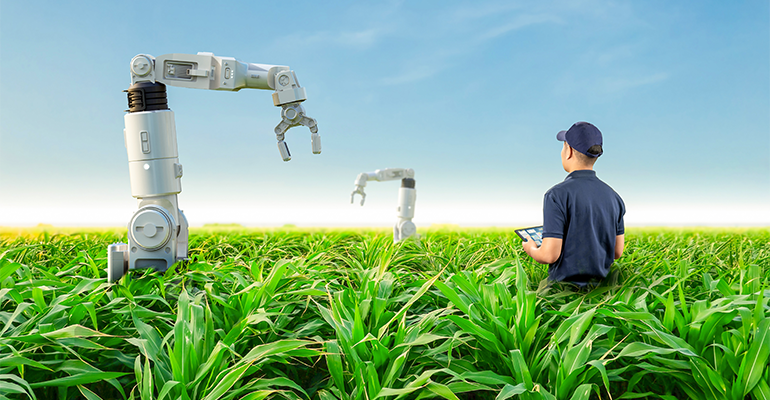
China has put artificial intelligence (AI) front and centre in its ambition “to reshape the global agricultural landscape”.
At a glance:
- China hopes new technology can help it scale production of novel ingredients and reduce reliance on animal agriculture.
- The technology will be used to help enhance sensory profiles and scale new proteins.
- Experts have warned the US and Europe that while they labour to develop alternative proteins, countries in Asia are accelerating.
The commitment to ‘leverage AI’ to lead the transition towards “efficient, green, resilient, and inclusive agri-food systems” was one of six key objectives agreed at September’s World Agri-Food Innovation (WAFI) conference, held in Beijing’s verdant Pinggu district.
Participants at the gathering, seen as the most important agriculture conference in China, also agreed to reduce food waste, strengthen research and technical capabilities in nutrition, control inputs, encourage international collaboration, and “translate policy consensus into practical action”.
Chinese political documents tend to be high-context, but the so-called ‘Pinggu consensus’ is seen as a big step in China’s ambition to lead in food innovation — including in alternative proteins.
In a blog outlining the real-world implications of the consensus agreed in China, experts at the Good Food Institute (GFI), which promotes alternative proteins, explained: “China believes that their country’s prolific integration of artificial intelligence into industrial manufacturing gives them a leg up on scaling production of ‘new proteins’. Expect China to lean heavily on domestic food manufacturers to more deeply integrate AI into their R&D and production systems, as a means of accelerating development of novel proteins that can match the taste and price of conventional animal counterparts.”
Using AI to advance food innovation
WAFI took place a few days before bosses from some of the world’s leading AI companies reportedly met at a state dinner with US President Donald Trump and Chinese leader Xi Jinping. A new AI dialogue between China and the US was agreed, with further talks set to take place this autumn as concerns rise over the regulation of the technology.
Food companies see plenty of potential in AI, including its ability to discover new ingredients, enhance sensory profiles, and shorten commercialisation timelines. This recently prompted the funding of a multimillion-dollar Food Intelligence Lab focused on creating better-tasting plant-based meat, for example.
Last year, China and Singapore also joined the Republic of Korea and Saudi Arabia to form a new United Nations working group designed to streamline international safety review processes for cultivated meat. China’s own national approval framework could come as soon as late 2026, according to local cultivated meat CEOs — potentially “creaking open the door” to a long-awaited market opportunity of “epic proportions”, according to GFI.
“China is running the same playbook it ran on solar and EVs [electric vehicles]: subsidies, regulatory coordination, and domestic market scale,” explained GFI founder and president Bruce Friedrich, following his keynote at the WAFI conference.
China is already ahead on patents, for example: Chinese entities, mostly public universities, hold eight of the top 20 cultivated meat patent portfolios. India is also stacking a bioeconomy strategy of $3 billion (€2.7 billion) on top of a pharma and vaccine manufacturing base that's already the largest outside the US, and that infrastructure “maps almost directly onto what cultivated meat needs”, said Friedrich on his Substack in September.
This could leave China, and perhaps India, in the driving seat when it comes to the alternative meat market. “The United States and Europe will still have extraordinary scientists, companies, and capital markets, so this is not foreordained,” wrote Friedrich. “But America and Europe have a familiar habit of inventing technologies and allowing China to dominate manufacturing; solar panels and EV batteries are obvious examples.”
Friedrich warned that if US support for the technology continues to retreat and the EU continues to make the regulatory path “so incredibly difficult”, China will once again dominate.
“This is a choice, and it can still go the other way. But if nothing changes, the centre of gravity [for alternative proteins] by 2031 will be Beijing and perhaps Delhi, not Washington,” he noted.
Behind the push for alternative proteins: Economics and geopolitics
Singapore-based researchers have said Asia’s carbon emissions goal cannot be met without diversifying the regional protein supply, and China is betting that through strategic investments — including hundreds of millions of dollars allocated for “biomanufacturing” by its State Development & Investment Corporation — it can successfully position itself as the primary sustainable-protein supplier to the world, said GFI.
Indeed, a recent report, commissioned by GFI APAC, highlighted that China’s capabilities to deliver fermentation-powered ingredients and proteins are “difficult to ignore”. The report noted: “Chinese companies and the Chinese government are committed to manufacturing novel foods at a competitive price point, more so than any other country on earth. This is directing China’s pre-existing strengths in fermentation into novel foods, and genuinely dropping prices.”
Consumers are also hungry for more meat, which has increased China’s reliance on imports. Nearly 90% of the country’s agricultural imports, by value, are animal feed like soybeans as well as animal and aquatic products, according to Professor Ke Bingsheng, former president of China Agricultural University.
China’s leaders are “understandably eager” to unshackle themselves from this import dependence and “liberate vast quantities of raw materials for human food production”, GFI suggested following a recent research trip to see the country’s biomanufacturing push first hand.
“By mastering the art of making protein from plants, microorganisms, and cultivated animal cells, China can produce a whole lot more of it and bolster national self-sufficiency,” said its APAC experts.
In an interview for the WAFI conference, Bingsheng explained that the “defining mission” for the next phase of China’s agricultural development was the journey from “enough” food to “good” food. This required "technological breakthroughs, scalable business models, pragmatic governance, and smart international engagement” working “in concert”.
Indeed, the consensus in Pinggu also agreed to “advance the green transformation of agriculture in response to food security and climate challenges by strictly managing resource inputs, protecting the ecology of cultivated land, and engaging diverse stakeholders to foster synergy between agricultural production, ecological conservation, and increased farmer income”.

Get more of our news on Google
Set Ingredients Network as a 'Preferred Source' to get quicker access to the news you value.
Related news
How manufacturers can reduce food loss in factory operations
4 Nov 2026
Small factory inefficiencies can send valuable ingredients down the drain, resulting in losses and prompting the sector to audit its waste-reduction methods. What solutions exist?
Read more
Whey protein production struggles to keep pace with demand
22 Oct 2026
Despite high whey protein prices and strong demand, growing production pressures are prompting questions about pricing sustainability, processing capacity, and alternative dairy options.
Read more
Manufacturers face volatility as food prices near four-year high
21 Oct 2026
Commodity pressures are mounting with the Food and Agriculture Organization’s (FAO) Food Price Index reaching its highest level since 2022.
Read more
Brazil pushes forward on restricting ultra-processed foods
14 Oct 2026
The Brazilian government is pushing ahead with its proposal calling on the World Health Organization (WHO) to restrict the marketing of ultra-processed foods – a move causing a mixed response.
Read more
UK biscuit maker pladis targets Chinese snack market for growth
6 Oct 2026
Pladis, the maker of iconic British biscuit brand McVitie’s, aims to boost disappointing profits by targeting China with products tailored to Chinese preferences.
Read more
Reinventing soda: Zero sugar, functional benefits, and new indulgence
30 Sep 2026
Zero-sugar, functional, and indulgent sodas are redefining what a carbonated soft drink can offer in today’s evolving market.
Read more
Is creatine going mainstream in food and drink formulation?
24 Sep 2026
The functional ingredient creatine is gaining traction in the food and drink industry, as brands ramp up production investment and explore new applications.
Read more
Is the FAO’s industrial aquaculture push harming ecosystems?
21 Sep 2026
The Food and Agriculture Organization (FAO) is promoting industrial aquaculture but campaigners say it creates toxic pollution and threatens food sovereignty.
Read more
Immunity, wellness, and nutrition: Nutraceutical promise in the Middle East and Africa
17 Sep 2026
Nutraceuticals continue to gain ground across the Middle East and Africa with vitamins, probiotics, and functional drinks doing particularly well, says Euromonitor.
Read more
Do the US dietary guidelines put UPFs under pressure?
10 Sep 2026
Will the US dietary guidelines change the way Americans eat, swapping ultra-processed foods for whole foods? We asked Dr Barry Popkin, renowned nutrition and obesity researcher.
Read more