
Ingredients Categories
Finished Products
Finished Food Categories
- Bakery
- Beverages / Juices
- Cereal and grain products
- Confectionery
- Cooking Fats & Oils
- Dairy
- Egg products
- Fruits & Vegetables
- Infant & Baby food
- Meat, Poultry & Fish
- Nuts & Seeds products
- Other Finished Food Categories
- Pet Food
- Plant-based foods
- Prepared foods
- Sauces & Seasonings
- Sweet & Savoury Spreads
Specialised Finished Products
- Bee products
- Biotic products
- Dietary supplements
- Energy drinks
- Functional beverages
- Functional confectionery
- Functional food
- Functional powders
- Meal replacement products
- Nutricosmetics
- Other Specialised Finished Products
- Pet Dietary Supplements
- Pharma and OTC products
- Protein products
- Sugar replacers / Sweeteners
Health & Wellness Areas
Delivery Formats
Operations & Services
- 3D printing
- Analysis/ Testing
- Auditing & certifications
- Blending & mixing
- Bottling
- Certification
- Clinical trials
- Co-packing
- Coating
- Consulting
- Contract manufacturing
- Drying
- Electrospinning
- Encapsulating
- Enzymatic processing
- Extracting
- Extrusion
- Fat structuring
- Fermentation
- Filling
- Flavour development
- Freeze drying
- Granulating/ grinding/ milling / mixing
- High-pressure processing
- Labelling
- Other Operations & Services
- Packaging
- Packet filling
- Pasturising
- Quality assurance
- Saccharification
- Shear cell processing
- Spray drying
- Sterilisation
- Storage & Logistics
- Tabletting
- Toasting / roasting
- Ultra-high temperature processing
News
Packaging power: Colour is 'the first and dominant cue', says expert
Kacey Culliney, Freelance Journalist 25 Nov 2026From Coca-Cola’s iconic red to Cadbury’s purple, packaging colour is a powerful neuroscience tool that captures attention, conveys quality, and even influences taste.
Neuroscience researchers in France recently conducted a review exploring the effects of packaging colour on product perception in the food and beverage industry.
At a glance:
- Packaging colour can heavily influence the perception of food and beverage products, including taste expectations.
- Many companies use colour to establish a signature brand image and stand out alongside competitors.
- Colours can also be used to convey taste profiles and enhance consumer experience of a product.
Published in Food Quality and Preference, findings suggest that packaging colour featuring warm hues increases expectations around sweetness and flavour intensity whilst cool hues are more often associated with healthiness. Darker, more saturated colours also signal less healthy but tastier products.
Overall, the researchers said research shows that colour mainly influences consumer perception before tasting – a finding Dr. Charles Spence, professor of experimental psychology at the University of Oxford and expert in multisensory marketing and perception, said is important for brands.
“Whilst more of our food shopping might be happening online, rather than in brick-and-mortar stores, in both cases vision is all you really have,” Spence told Ingredients Network. Sometimes sound comes into play, with the noise of packaging when being held or opened, but the visual cues and shape information of a product are the first and most important sensory message shoppers receive, he explained. “Within this, it is colour that is said to be the first and dominant cue of the different visual cues.”
Brand power and product promotion
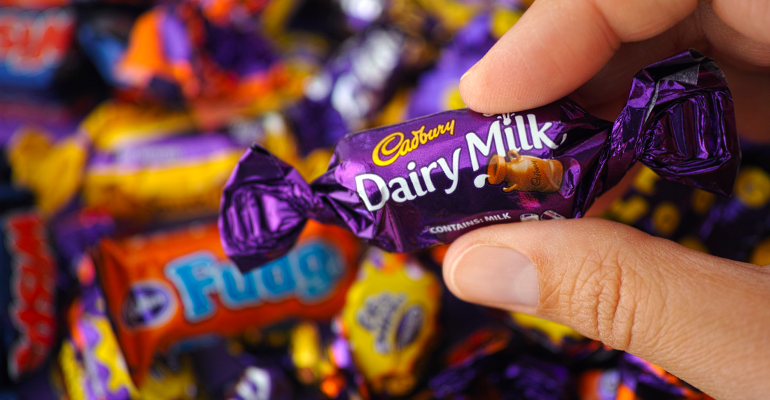
Spence said that food and beverage companies often use coloured packaging to establish a signature brand colour that helps a product stand out on shelf and create appeal. Confectionery major Cadbury is one good example here, with its “iconic colour cue” purple used across its chocolate bar products, as is beverage major Coca-Cola, renowned for its bright red and white packaging combination.
But colour cues can also be used in the food and beverage space for quick messaging, the expert said. Green, red, and blue on milk bottles, for example, can quickly signal no-fat, low-fat or full-fat varieties and similar colour trends across meat packaging can help differentiate between pork, beef, chicken, and lamb.
Classic colour cues: Bombay Saphire’s blue and Cadbury’s purple
Colour can also be used as a way to differentiate from competition in a more creative way, Spence said. In the spirits aisle, for example, gin brand Bombay Sapphire stands out alongside competitors thanks to its light blue glass bottle.
Colour choice, however, must be carefully considered given how influential it is on shopper perception and how important it is that packaging and a product work well visually together, he said.
Cadbury's purple, for example, “offers the perfect colour contrast with the chocolate”; Heinz's turquoise blue label on its tinned baked beans contrasts perfectly with the orange beans; and Barilla's navy blue and yellow packaging makes the pasta look more golden through the transparent window on-pack, he said.
How coloured packaging influences taste and quality
Beyond this, Spence said colour can, importantly, influence taste and overall experience of consuming a product. Many studies have been conducted on crisps, for example, showing that consumers struggle to identify a flavour without the expected colour cues on a pack. In 2011, Coca-Cola also released a white polar bear-themed Christmas can, leading to a raft of consumer complaints that the beverage tasted different, despite no change being made to the formulation, he said.
The review finding that warm hues signal tastier and cool hues signal healthier is interesting, Spence said. “Perhaps there's an evolutionary context here. We humans developed trichromatic colour vision; seeing the reds and warmer hues in amongst the green forest-jungle canape and so we've learned through evolution that these warmer hues in food are correlated with sweetness and ripeness.”
Today, he said evidence suggests that pinks may be even “more effective than reds at conveying sweet expectations” across food and drink – either on the packaging or in the actual product.
According to the review, colour packaging mostly shapes pre-tasting expectations but can fade after sampling. This, according to Spence, can certainly be true because, beyond perception and expectations, a product still has to deliver.
“Sometimes the temptation to try and stand out if you're a new player or product means you might break away from the category norms,” he said, and whilst this may capture attention once, it's hard to succeed longer-term.
“Ideally, I think packaging should be distinctive and signature through sight, feel or sound, so that the consumer immediately knows it's your brand,” the expert said. Beyond this, companies must prioritise use of functional colours that influence product perception and consumer expectations in the right direction. “Given how important packaging colour and features are to setting our expectations and changing the taste and experience of the product, companies need to think about how these things work together.”
Looking ahead, Spence said food and drink companies should also focus on how packaging looks online, considering fonts, images, and colours that work when a product is being viewed individually versus alongside competitors in-store. Knowing the background colour of some of the leading shopping websites, for example, and whether your product colours work in this setting is key, he said.

Get more of our news on Google
Set Ingredients Network as a 'Preferred Source' to get quicker access to the news you value.
Related news

Saudi Arabia pursues global halal certification
17 Nov 2026
Saudi Arabia is pushing for harmonised global halal certification to unify standards worldwide and boost food development.
Read more
Supermarket cyber-attacks: How can retailers protect themselves?
11 Nov 2026
Cyber-attacks have hit supermarket refrigeration systems across Europe in recent weeks, highlighting the need for a coordinated response to cybercrime, says one expert.
Read more
China bets big on AI to ‘reshape’ the global agri-food system
10 Nov 2026
Leveraging AI is part of the Chinese government’s six-point consensus to deliver on its agri-food ambitions.
Read more
How manufacturers can reduce food loss in factory operations
4 Nov 2026
Small factory inefficiencies can send valuable ingredients down the drain, resulting in losses and prompting the sector to audit its waste-reduction methods. What solutions exist?
Read more
Whey protein production struggles to keep pace with demand
22 Oct 2026
Despite high whey protein prices and strong demand, growing production pressures are prompting questions about pricing sustainability, processing capacity, and alternative dairy options.
Read more
Manufacturers face volatility as food prices near four-year high
21 Oct 2026
Commodity pressures are mounting with the Food and Agriculture Organization’s (FAO) Food Price Index reaching its highest level since 2022.
Read more
Brazil pushes forward on restricting ultra-processed foods
14 Oct 2026
The Brazilian government is pushing ahead with its proposal calling on the World Health Organization (WHO) to restrict the marketing of ultra-processed foods – a move causing a mixed response.
Read more
UK biscuit maker pladis targets Chinese snack market for growth
6 Oct 2026
Pladis, the maker of iconic British biscuit brand McVitie’s, aims to boost disappointing profits by targeting China with products tailored to Chinese preferences.
Read more
Reinventing soda: Zero sugar, functional benefits, and new indulgence
30 Sep 2026
Zero-sugar, functional, and indulgent sodas are redefining what a carbonated soft drink can offer in today’s evolving market.
Read more
Is creatine going mainstream in food and drink formulation?
24 Sep 2026
The functional ingredient creatine is gaining traction in the food and drink industry, as brands ramp up production investment and explore new applications.
Read more