
Ingredients Categories
Finished Products
Finished Food Categories
- Bakery
- Beverages / Juices
- Cereal and grain products
- Confectionery
- Cooking Fats & Oils
- Dairy
- Egg products
- Fruits & Vegetables
- Infant & Baby food
- Meat, Poultry & Fish
- Nuts & Seeds products
- Other Finished Food Categories
- Pet Food
- Plant-based foods
- Prepared foods
- Sauces & Seasonings
- Sweet & Savoury Spreads
Specialised Finished Products
- Bee products
- Biotic products
- Dietary supplements
- Energy drinks
- Functional beverages
- Functional confectionery
- Functional food
- Functional powders
- Meal replacement products
- Nutricosmetics
- Other Specialised Finished Products
- Pet Dietary Supplements
- Pharma and OTC products
- Protein products
- Sugar replacers / Sweeteners
Health & Wellness Areas
Delivery Formats
Operations & Services
- 3D printing
- Analysis/ Testing
- Auditing & certifications
- Blending & mixing
- Bottling
- Certification
- Clinical trials
- Co-packing
- Coating
- Consulting
- Contract manufacturing
- Drying
- Electrospinning
- Encapsulating
- Enzymatic processing
- Extracting
- Extrusion
- Fat structuring
- Fermentation
- Filling
- Flavour development
- Freeze drying
- Granulating/ grinding/ milling / mixing
- High-pressure processing
- Labelling
- Other Operations & Services
- Packaging
- Packet filling
- Pasturising
- Quality assurance
- Saccharification
- Shear cell processing
- Spray drying
- Sterilisation
- Storage & Logistics
- Tabletting
- Toasting / roasting
- Ultra-high temperature processing
News
Pistachio supply concerns spur diversified sourcing strategies
Natasha Spencer-Jolliffe, Freelance Journalist 1 Jul 2026Geopolitical and climate-change shocks have highlighted the threats to pistachio supply, prompting alternative formulations and long-term sourcing solutions.
The blockade of the Strait of Hormuz in recent months has shone a spotlight on restricted pistachio supplies. Iran is the second-largest pistachio producer in the world, behind the US and ahead of Turkey. It accounts for almost a fifth (18%) of global supply, producing 200,000 metric tonnes in the 2025/2026 season.
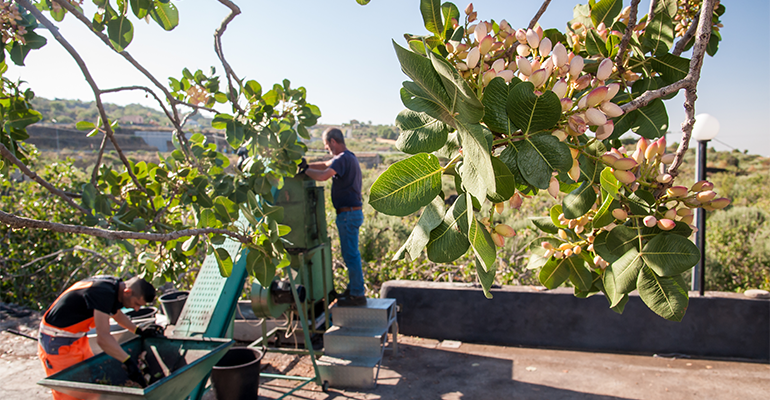
An ingredient under pressure
In March 2026, Bloomberg pistachio prices reached an eight-year high of €3.98 ($4.57) per pound. Key ports near the Strait of Hormuz have been heavily affected by the war, severely disrupting the growers' ability to transport pistachios to global markets. According to MSN, Iranian customs data shows pistachio exports decreased by 30% between March and May 2026 compared to the previous year.
Prior to the Iranian war breaking out, the pistachio market was already under strain. Drought hindered harvest production in its core markets in 2025.
Then, in January 2026, the government in Tehran closed down the internet in response to internal unrest, restricting exporters' and foreign buyers' communication channels.
Pistachios: A trending ingredient
Supply limitations coincide with a boom in demand for pistachios, particularly the Tik Tok-led “Dubai chocolate” trend. The product uses substantial amounts of pistachio kernels in the pistachio cream filling, placing additional pressure on producers to develop formulation solutions.
To keep up with demand, Iranian producers exported 40% more pistachios to the United Arab Emirates (UAE) in the six months to March 2025 than in the entire prior year.
Perhaps surprisingly, supply shortages have not deterred brands, Big-name brands like Lindt & Sprüngli and Ritter Sport introduced new creations and Aero introducing its new pistachio-flavoured chocolate bar in April 2026.
Formulations free from pistachios
Pistachios are tree crops and it takes between five and 10 years from planting for them to reach significant production. Although other suitable places to grow pistachio trees exist, over 85% are currently grown in the US, Iran, and Turkey.
“[This means] their supply cannot be significantly diversified in the short term,” Peter Wortsman, partner at EFFP, an agri-food consultancy, told Ingredients Network. “As prices increase due to supply shortages, both consumers and food manufacturers will likely substitute away from pistachios,” Wortsman said.
For food manufacturers, a potential rise in pistachio costs may require recipe reformulation. Swapping ingredients or modifying ingredient ratios would allow manufacturers to use fewer pistachios. Brands could explore using other nuts, seeds, nut extracts, edible oils, or even food colouring to achieve a green pistachio colour, depending on the product.
A long-term perspective is lacking
To increase resilience, food industry attention should turn to how to prevent similar shortages in the future. Transforming pistachio production to protect it against unpredictable, volatile changes in the food system requires investment and a new diversification strategy.
However, the economics of the food industry may be a barrier to maintaining a strong, sufficient pistachio supply that meets consumer demand.
“Unfortunately, decision makers and investors in food businesses are rarely incentivised to make investments which only pay off in the medium and longer term,” said Wortsman. “This has resulted in a fragile food system increasingly exposed to climate, market and geopolitical shocks.”
Food manufacturers that use pistachios in their current formulations, or want to ensure sufficient supply for new product developments, will need to build resilience to future shocks, reduce costs and grow market share.
Strengthening relationships along the value chain and exploring new supply sources can help ensure sufficient and ongoing access to pistachios. “There is an opportunity to work with growers and invest in diversifying their supply today, though this requires a longer-term perspective and commitment,” Wortsman added.

Get more of our news on Google
Set Ingredients Network as a 'Preferred Source' to get quicker access to the news you value.
Related news

Do the US dietary guidelines put UPFs under pressure?
10 Sep 2026
Will the US dietary guidelines change the way Americans eat, swapping ultra-processed foods for whole foods? We asked Dr Barry Popkin, renowned nutrition and obesity researcher.
Read more
Health and wellness engagement matures across Middle East and Africa
4 Sep 2026
Many consumers in the Middle East and Africa are now proactively engaged in health and wellness, looking to integrate better habits and products into their daily lives, say experts.
Read more
Skimpflation: An ‘unfair’ and risky approach to keeping prices low
2 Sep 2026
Consumers see skimpflation – reducing the quality of ingredients due to rising costs – as more unfair than shrinkflation, making it a risky strategy according to recent research.
Read more
‘Urgent gaps’ in achieving 2030 food system goals
27 Aug 2026
Global food systems are failing to meet 2030 targets across indicators including health, environment, and resilience, according to a report co-authored by the Food and Agriculture Organisation (FAO).
Read more
Seven-Eleven uses microbial testing tech to extend katsudon shelf life
26 Aug 2026
Japanese retail company Seven-Eleven has improved its factory’s microbial environment to keep comfort-food staple, katsudon, fresher for longer.
Read more
Chimac’s fusion sauces bring Korean flavours to Europe
25 Aug 2026
Irish sauce brand Chimac is tapping into Korea’s culinary traditions, bringing its flavours and products to European consumers who want a taste of K-food.
Read more
Global demand for instant noodles continues to rise
24 Aug 2026
Global demand for instant noodles reached 124.21 billion servings last year, representing a 0.7% year-on-year increase – or 900 million extra servings.
Read more
Popular barbecue staples experience sharp price increases
19 Aug 2026
The typical cost of US shoppers’ barbecue baskets has risen by 12% over the past year – the fastest annual rise in a decade, figures from The Economist show.
Read more
Hot NPD: Nissin launches first cold-water Cup Noodles
18 Aug 2026
Nissin is taking one of Japan’s most iconic instant meals in a completely new direction with the launch of the first cold water-only Cup Noodles in the brand’s 55-year history.
Read more
Manam Chocolate aims to bring premium Indian cacao to 'the world stage'
11 Aug 2026
Craft chocolate brand Manam Chocolate is investing in local expansion and supply chain innovation throughout India as it works to build out the premium reputation of its locally produced cacao products.
Read more