
Ingredients Categories
Finished Products
Finished Food Categories
- Bakery
- Beverages / Juices
- Cereal and grain products
- Confectionery
- Cooking Fats & Oils
- Dairy
- Egg products
- Fruits & Vegetables
- Infant & Baby food
- Meat, Poultry & Fish
- Nuts & Seeds products
- Other Finished Food Categories
- Pet Food
- Plant-based foods
- Prepared foods
- Sauces & Seasonings
- Sweet & Savoury Spreads
Specialised Finished Products
- Bee products
- Biotic products
- Dietary supplements
- Energy drinks
- Functional beverages
- Functional confectionery
- Functional food
- Functional powders
- Meal replacement products
- Nutricosmetics
- Other Specialised Finished Products
- Pet Dietary Supplements
- Pharma and OTC products
- Protein products
- Sugar replacers / Sweeteners
Health & Wellness Areas
Delivery Formats
Operations & Services
- 3D printing
- Analysis/ Testing
- Auditing & certifications
- Blending & mixing
- Bottling
- Certification
- Clinical trials
- Co-packing
- Coating
- Consulting
- Contract manufacturing
- Drying
- Electrospinning
- Encapsulating
- Enzymatic processing
- Extracting
- Extrusion
- Fat structuring
- Fermentation
- Filling
- Flavour development
- Freeze drying
- Granulating/ grinding/ milling / mixing
- High-pressure processing
- Labelling
- Other Operations & Services
- Packaging
- Packet filling
- Pasturising
- Quality assurance
- Saccharification
- Shear cell processing
- Spray drying
- Sterilisation
- Storage & Logistics
- Tabletting
- Toasting / roasting
- Ultra-high temperature processing
News
Rising automation requires clear risk management strategy
Natasha Spencer-Jolliffe, Freelance Journalist 6 Apr 2026Automation is helping manufacturers reduce bottlenecks but it also comes with risks. Successful brands will have clear risk management strategies.
Automation’s primary goal is to supervise and optimise processing phases while reducing labour costs, which account for around 50% of total production costs. Automation can plug this labour gap, reducing dependency while improving production efficiency and bolstering quality assurance.
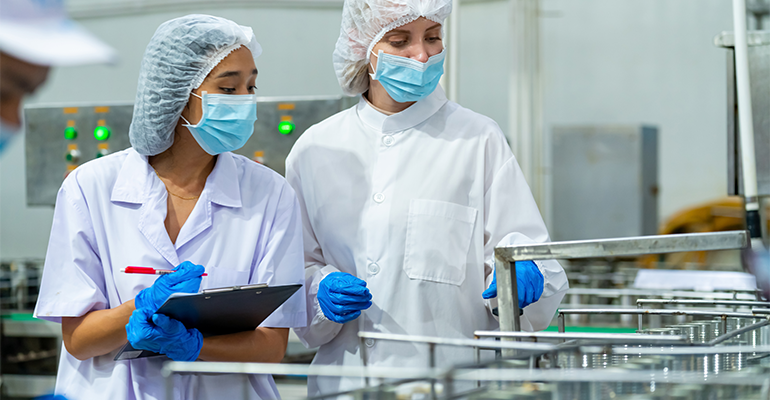
Research indicates that adopting automation is a key strategy for countries like Japan, which has an ageing population and experiences labour shortages.
Manufacturers are increasingly adopting automation throughout their operations and processing stages across different food and drink categories.
In its recent State of the Industry report, the UK food industry trade association, Food and Drink Federation (FDF), found that companies are investing in increased automation. Companies of all sizes, but particularly small and medium enterprises (SMEs), plan to use automation to address labour shortages.
Staff are a key part of this investment, though, with 24% of companies confirming they plan to increase skills and training investment to upskill existing staff and enable them to deliver automation. This figure was 8% in the FDF’s previous report.
In a 2025 report, McKinsey Global Institute confirms that our future workplaces will be a partnership among people, agents and robots.
A negative impact on flexibility
“Automation is essential to remain competitive – but it can make you less flexible,” Mathew Simpson, sales manager at CSB-System, told this publication.
CSB-System is a US company that provides enterprise resource planning (ERP) software solutions for various industrial sectors, including the food industry.
Automation technology during installation can, for instance, determine a product’s packaging size. If the technology locks in this specific size without room for modification, it will apply it throughout product development. Changing the size will then require significant investment and a long lead time.
The worst-case scenario for manufacturers is that changing the packaging size might not be possible, resulting in lost investment, ingredients, materials and time. Best case, the changeover time may take longer and require more specialist skills, where in the past a line leader or in-house technician would correct the sizing and restart manufacturing.
Automation challenges can be met with automation solutions. Where a longer changeover time is required, manufacturers may use palletising robots to correct errors and boost productivity, reducing lost lead time.
As robotic picking and automation have become more widespread in food and drink manufacturing, programming has become easier. Yet, teaching robots a new stacking pattern is often more complex than communicating this to staff. However, if a manufacturer’s robot can only handle a maximum pack size that falls short of a new customer's demands, it can’t be used.
“It is important to try to think several moves ahead and build in as much flexibility as possible to support possible new products or processes in future,” said Simpson.
Calibration, creativity, and complacency concerns
Manufacturers using automation in their product development process need to calibrate the technology to fit the rest of the process.
“You can’t go faster than your bottleneck,” said Simpson.
Introducing automation and increasing capacity in primary processes will not speed up production and performance if manufacturers have to stop the line to let downstream processes catch up.
Also, while automated systems often increase line speeds and throughput, an equipment breakdown can lead to a much larger drop in production volume, which may require specialist technicians to fix.
“Automation tends to make you less self-sufficient: you come to rely on third-party companies to fix or maintain automated systems,” said Simpson.
While this can free up time and energy to focus on adding process value, automation can mean manufacturers lose this element of creative problem-solving. It leaves them dependent on the third party's timetables and capacity, and you may not always get service as soon as you want.
Automation tends to reduce errors, but it can also lead to complacency among operatives, causing problems to go unnoticed for too long.
“You can delegate tasks but not responsibility,” said Simpson. Automation systems may run correctly 99% of the time. Manufacturers may then become solely reliant on the assumption that nothing will ever go wrong and that the machines are responsible for output.
Machines and automated systems can also malfunction.
“More often than that, they can be fed with the wrong information or not updated with new information,” said Simpson.
An automated system could, for instance, apply the wrong label, heat process or stacking pattern. Manual checks, therefore, still need to be maintained despite the logical intuition, based on experience, that they are not necessary most of the time.

Get more of our news on Google
Set Ingredients Network as a 'Preferred Source' to get quicker access to the news you value.
Related news

Do the US dietary guidelines put UPFs under pressure?
10 Sep 2026
Will the US dietary guidelines change the way Americans eat, swapping ultra-processed foods for whole foods? We asked Dr Barry Popkin, renowned nutrition and obesity researcher.
Read more
Health and wellness engagement matures across Middle East and Africa
4 Sep 2026
Many consumers in the Middle East and Africa are now proactively engaged in health and wellness, looking to integrate better habits and products into their daily lives, say experts.
Read more
Skimpflation: An ‘unfair’ and risky approach to keeping prices low
2 Sep 2026
Consumers see skimpflation – reducing the quality of ingredients due to rising costs – as more unfair than shrinkflation, making it a risky strategy according to recent research.
Read more
‘Urgent gaps’ in achieving 2030 food system goals
27 Aug 2026
Global food systems are failing to meet 2030 targets across indicators including health, environment, and resilience, according to a report co-authored by the Food and Agriculture Organisation (FAO).
Read more
Seven-Eleven uses microbial testing tech to extend katsudon shelf life
26 Aug 2026
Japanese retail company Seven-Eleven has improved its factory’s microbial environment to keep comfort-food staple, katsudon, fresher for longer.
Read more
Chimac’s fusion sauces bring Korean flavours to Europe
25 Aug 2026
Irish sauce brand Chimac is tapping into Korea’s culinary traditions, bringing its flavours and products to European consumers who want a taste of K-food.
Read more
Global demand for instant noodles continues to rise
24 Aug 2026
Global demand for instant noodles reached 124.21 billion servings last year, representing a 0.7% year-on-year increase – or 900 million extra servings.
Read more
Popular barbecue staples experience sharp price increases
19 Aug 2026
The typical cost of US shoppers’ barbecue baskets has risen by 12% over the past year – the fastest annual rise in a decade, figures from The Economist show.
Read more
Hot NPD: Nissin launches first cold-water Cup Noodles
18 Aug 2026
Nissin is taking one of Japan’s most iconic instant meals in a completely new direction with the launch of the first cold water-only Cup Noodles in the brand’s 55-year history.
Read more
Manam Chocolate aims to bring premium Indian cacao to 'the world stage'
11 Aug 2026
Craft chocolate brand Manam Chocolate is investing in local expansion and supply chain innovation throughout India as it works to build out the premium reputation of its locally produced cacao products.
Read more